Self-reflection
A rune’s theme can point to a motive or a worry you had not put into words.

Runes are the letters of the old Germanic alphabets. The oldest set, the Elder Futhark, has 24 signs. The earliest inscriptions that use it date to around the 2nd century CE.
Each rune had a sound and a name, and many names are ordinary words. Fehu means cattle or wealth, Uruz is the aurochs, a wild ox, and Thurisaz is a giant. Modern readers treat these names as themes to think with when they draw a rune for a question.
That modern use is a symbolic practice, not a proven forecast. The historical evidence for rune divination is thin, and we explain why further down. If you use runes, use them as prompts for reflection.
Most questions fall into three areas. For each one, a rune gives you a single theme to test against your situation.
"What am I good at?", "What do I keep putting off?"
"What do I want from this relationship?", "What am I not saying?"
"Is this a good time to change jobs?", "What is holding this project back?"
At best a rune draws your attention to something you already half know, and the decision stays yours.

Write the question down first, in one sentence. Mix the runes in a bag or face down on a table and draw one without looking. Read the rune’s name and traditional theme, then ask how it fits your question. Note your first reaction before you look anything up.
One rune: a single theme for one question or for the day.
Three runes: situation, obstacle and a possible next step, read left to right.
Reversed runes: some readers give an upside-down rune a different reading, others ignore direction. Pick one rule and keep it.


Take a question you are stuck on and do the three-rune draw described above. Write down what each one makes you think of. Put the notes aside for a day, then read them again.
A reading compares each rune’s traditional theme with your situation.
The traditional themes come from medieval rune poems in Old English, Old Norwegian and Old Icelandic, which give a short verse for each rune. Modern meanings build on those verses and add a lot of 20th-century interpretation.


Runic writing was used across Germanic-speaking Europe from around the 2nd century CE. Around the 8th century, Scandinavians reduced the 24 signs to the 16-rune Younger Futhark. In England the alphabet grew to about 30 signs, known as the Anglo-Saxon futhorc.
Runes were carved into stone, wood, bone, metal and weapons. Many surviving inscriptions are names, memorials and owner marks. Some contain charm words such as alu, whose exact meaning scholars still debate.
Runology is an academic field. Scholars catalog runic inscriptions, date them and read them as a source on language, names and beliefs. Sweden alone has thousands of rune stones, most of them from the Viking Age.
The evidence for runes as a fortune-telling tool is much weaker. The Roman writer Tacitus described Germanic lot casting with marked strips of wood, but he did not say the marks were runes. Most rune divination systems in use today took shape in the 20th century.

Draw one rune each morning and write one line about it. At the end of the week, read the seven lines together. Look for a theme or a worry that comes up more than once.

Used as a prompt, a rune can slow you down before a decision and give you one word to focus on.
It cannot predict events, diagnose health problems or replace advice from a doctor, lawyer or financial professional. If a draw leaves you anxious, stop and take the question to a person you trust.
Drawing a rune takes a minute. In that minute you stop and name the question you want answered.

A rune’s theme can point to a motive or a worry you had not put into words.
When you are stuck, reading a random theme against the problem can show it from a side you had not checked.
Ask the same question next month and you may read the draw differently, because your situation has moved on.
A draw can help you list your options and say why you lean toward one of them.
Three steps, about five minutes

Tarot uses 78 picture cards. Runes are 24 letter signs, each with a name and a short traditional theme, so a reading is sparser and leaves more to your own interpretation.
No. You can use a draw purely as a writing prompt, without believing anything about the runes themselves.
Questions about choices you control work best, such as how to handle a work project or a hard conversation. Leave health, legal and money decisions to a professional, because a rune can’t answer those.
There is no evidence that they can. Use a draw to think about the present, and base decisions on facts.
A set of 24 Elder Futhark runes, or 24 slips of paper with the signs drawn on them, a small bag or cloth, and a notebook.
Not necessarily. A rune with a hard theme, such as Hagalaz (hail), describes a kind of situation. Read it as a question about what you can prepare for.
As often as it stays useful. If you keep redrawing for the same question to get a different answer, stop and decide on the facts, or talk it over with someone.
Make it open and about you. “What should I watch for in this job change?” works better than “Will I get the job?”
Do the next step you settled on, if there is one. Keep a note of the rune so you can compare it with later draws.
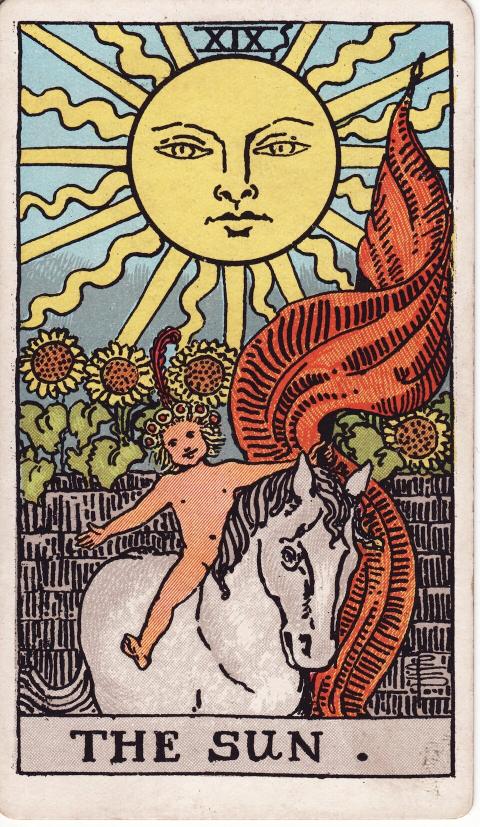
The Sun tarot card meaning: joy, success, things out in the open. Why Waite’s reversed Sun is only dimmer, love and yes or no, and why 19 never sits mid-matrix.