When the Ace of Swords comes up, something has just become clear, sharply enough that you can say it out loud or act on it. Reversed, the sharpness misfires, as muddled thinking or a remark that cuts deeper than you meant.
In the 78-card deck, fourteen cards make up the Swords, and this Ace is first in line. It shares the hand-and-cloud design of the Ace of Cups, but here the hand comes from the left and closes into a fist.
| Upright keywords | Reversed keywords |
|---|---|
| A clear idea, a breakthrough | Muddled thinking |
| Plain truth, said out loud | Harsh words |
| A firm decision | Power used badly |
What the card shows
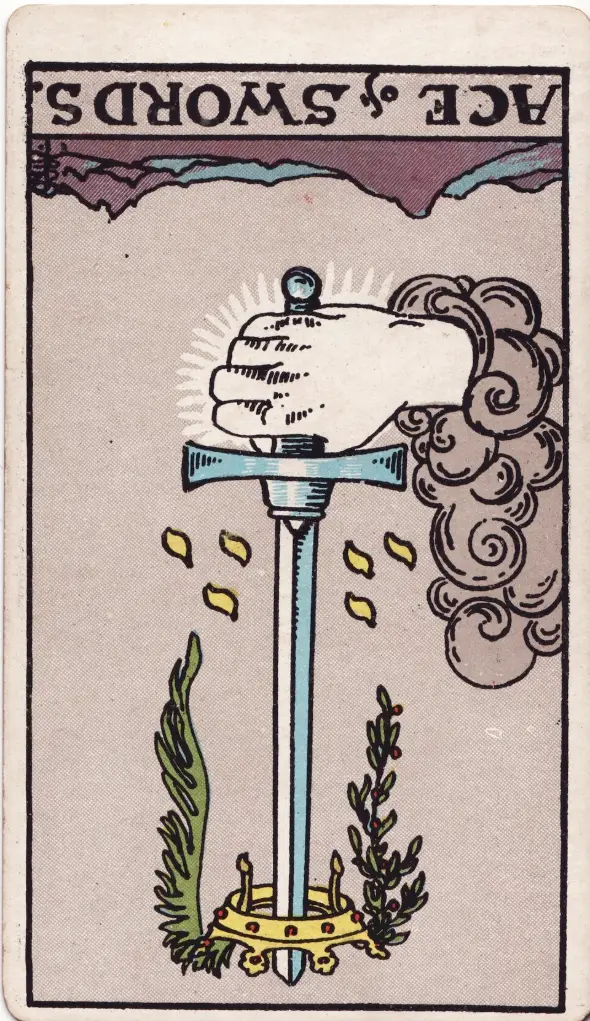
From a gray cloud at the left edge, a white fist closes around the hilt of an upright sword. A thin fringe of light rays surrounds the hand. The blade is pale blue and white, with a wide crossguard above the fist and a round pommel showing below it.
Near the tip, the blade passes through a gold crown studded with small red jewels. A leafy sprig with red berries hangs from the crown on the left, a long green frond on the right. Six yellow drops shaped like small flames drift down, three on each side of the blade. Along the bottom runs a range of purple and blue-gray mountains, bare of trees, people or water.
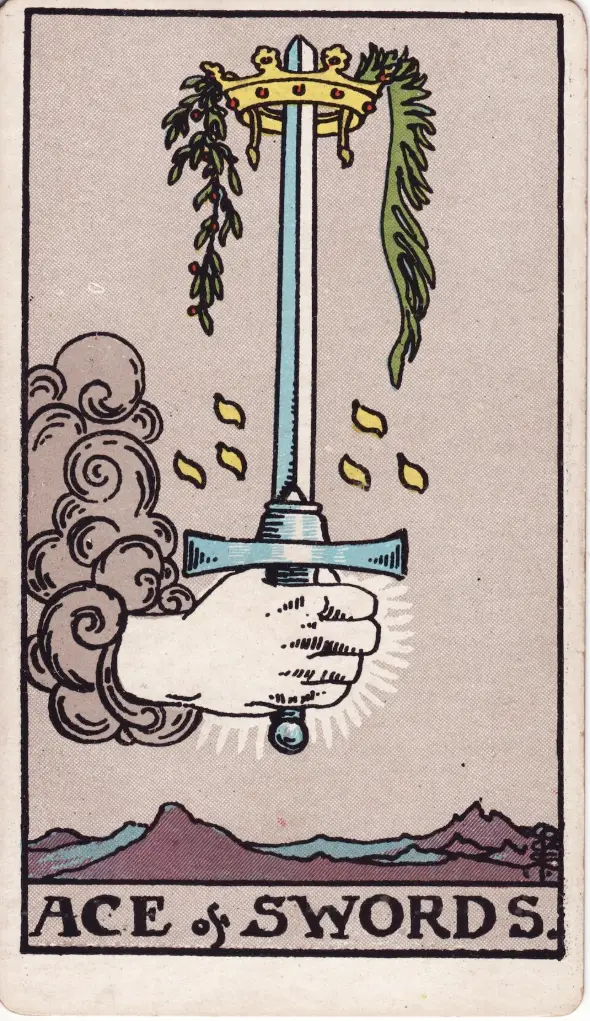
Waite says only that the crown may carry a meaning beyond ordinary card reading:
“a much higher significance than comes usually within the sphere of fortune-telling”
A. E. Waite, on the crown of the Ace of Swords, The Pictorial Key to the Tarot (1910). Source: Wikisource, Part III, read November 22, 2026.
A longer account of this Ace comes from the Golden Dawn, the occult society Waite had once joined. Aleister Crowley printed it openly in his journal The Equinox in 1912. There the card is called the Root of the Powers of the Air, and the text says “Six Vaus fall from its point.” Vau is a letter of the Hebrew alphabet, and Smith drew exactly six drops.
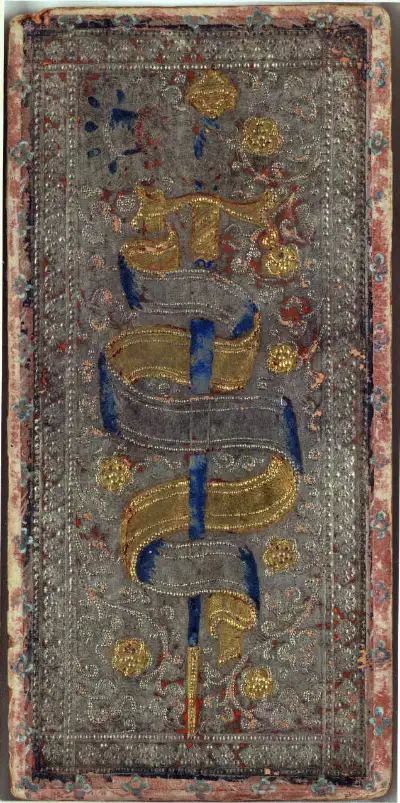
Yale’s Beinecke Library holds a far older Ace of Swords from the hand-painted Cary-Yale Visconti deck, one of 67 cards that survive from that 15th-century set. A single sword hangs point down on tooled silver, with a long blue and gold ribbon wound around the blade and no hand to hold it.
Ace of Swords upright
A student who has read the same chapter three times suddenly sees how the argument fits together and drafts the essay in one evening. You tell your brother, calmly and in one sentence, that he can’t borrow the car again. Twenty minutes into a chess game, the move you kept missing becomes obvious.
“It is a card of great force, in love as well as in hatred.”
A. E. Waite, divinatory meanings of the Ace of Swords, The Pictorial Key to the Tarot (1910). Source: Wikisource, Part III, read November 22, 2026.
Triumph and conquest head his list, and the blade on the card wears a crown. Because of the line about love and hatred, we also use the Ace in questions about people. There it can mean a firm conviction about someone, for or against.
Ace of Swords reversed
With the card reversed, the crown hangs under a blade that now points down.
“The same, but the results are disastrous”
A. E. Waite, the Ace of Swords reversed, The Pictorial Key to the Tarot (1910). Source: Wikisource, Part III, read November 22, 2026.
In Waite’s reading, the force survives intact but is aimed badly. One blunt message in a group chat splits a circle of friends. A family decision gets rushed through before anyone has heard the whole story.
Half-formed ideas can also crowd your head until not one of them gets finished. You sketch four plans for the garden and plant nothing.
Ace of Swords in love
Looking for a partner, you may at last get clear on what you want in one. That can mean admitting the person you’ve chased for months doesn’t fit the picture.
The Ace asks couples to be honest early, and kindly. You tell your partner, before anything is booked, that you’d rather not spend every holiday with their parents.
Reversed, you might criticize a partner’s cooking in front of their friends.
Career and work
In work questions, the Ace backs a clear brief, a sharp proposal or the day a new skill clicks, such as a spreadsheet formula you’d been copying blindly for a year. In his short section of extra meanings, Waite gives the card “Inflexible will.” That suits someone who keeps a good idea alive under pushback.
Turned over, it’s the email sent in anger late at night, or a plan forced through that the team quietly ignores.
Money
For your finances, the Ace means one honest look at the numbers. You add up every subscription and cancel the four you forgot about, or set a rule to wait a day before any purchase over a hundred dollars.
The sword sharpens your thinking about your own spending. It won’t say which way a share price or a house price will move.
In reverse, a budget gets cut so hard it collapses within a week.
Ace of Swords as feelings
They see you clearly, and they probably have an opinion they’re ready to share. That interest tends to show up as directness more than as flowers.
Upside down, they can’t make up their mind about you, or they’ve found fault and said nothing yet.
Ace of Swords as advice
Say the plain version. Write the decision down, short enough to fit on a sticky note, and act on it before the week is out.
Reversed, drop all but one of the half-finished plans.
Yes or no
On questions about speaking up or making a decision, the upright Ace is a firm yes. Reversed, the yes becomes a no until you’ve calmed down and checked your facts.
Questions about the Ace of Swords
What do the olive branch and palm on the Ace of Swords mean?
The Golden Dawn’s 1912 text calls one “the olive branch of Peace” and the other “the palm branch of suffering.” Waite mentions neither plant. Our reading pairs them with the two ways a hard truth can land, as relief or as hurt.
Can the Ace of Swords mean the truth will come out?
The truth it brings out is usually one you reach yourself, by thinking a problem through or in a talk you finally have. It can’t see what someone else is hiding, though, so we wouldn’t treat it as proof that a secret is about to surface.
Is the sword on the Ace of Swords double-edged?
Smith drew a straight blade with a ridge down the center and a symmetrical point. Waite’s text doesn’t describe its edges, but the blade is usually called double-edged. Each edge then stands for one use of a sharp mind, to clear things up or to cut someone down.
Sources
- A. E. Waite, The Pictorial Key to the Tarot, London: William Rider & Son, first published 1910 (Wikisource transcribes the 1922 reprint). Public domain. Part III: the Ace of Swords with its divinatory and reversed meanings, and the additional meanings of the Lesser Arcana: Wikisource. Read November 22, 2026.
- The Equinox, Vol. I, No. 8 (London, 1912), “A Description of the Cards of the Tarot with their Attributions”: the titles of the cards and the description of the Ace of Swords: PDF copy. Read November 22, 2026.
- Tarot card reading, the Golden Dawn origin of the Rider-Waite-Smith meanings, Waite’s membership and the 1912 publication of the order’s tarot text in The Equinox: Wikipedia. Read November 22, 2026.
- Visconti-Sforza Tarot, the 67 surviving cards of the Cary-Yale deck: Wikipedia. Read November 22, 2026.
- Images: Ace of Swords, Rider-Waite-Smith deck, card art by Pamela Colman Smith, 1910, public domain, Wikimedia Commons. Ace of Swords, Cary-Yale Visconti tarot, 15th century, Beinecke Rare Book & Manuscript Library, public domain, Wikimedia Commons. Both file pages read November 22, 2026.
Related cards
- Previous card: King of Swords
- Next card: Two of Swords
- All 78 tarot card meanings
- Free tarot reading