Table of Contents:
You don’t have to reinvent the wheel. Someone has walked this path before you. The wisdom you’re seeking already exists—you just need the right teacher to unlock it.
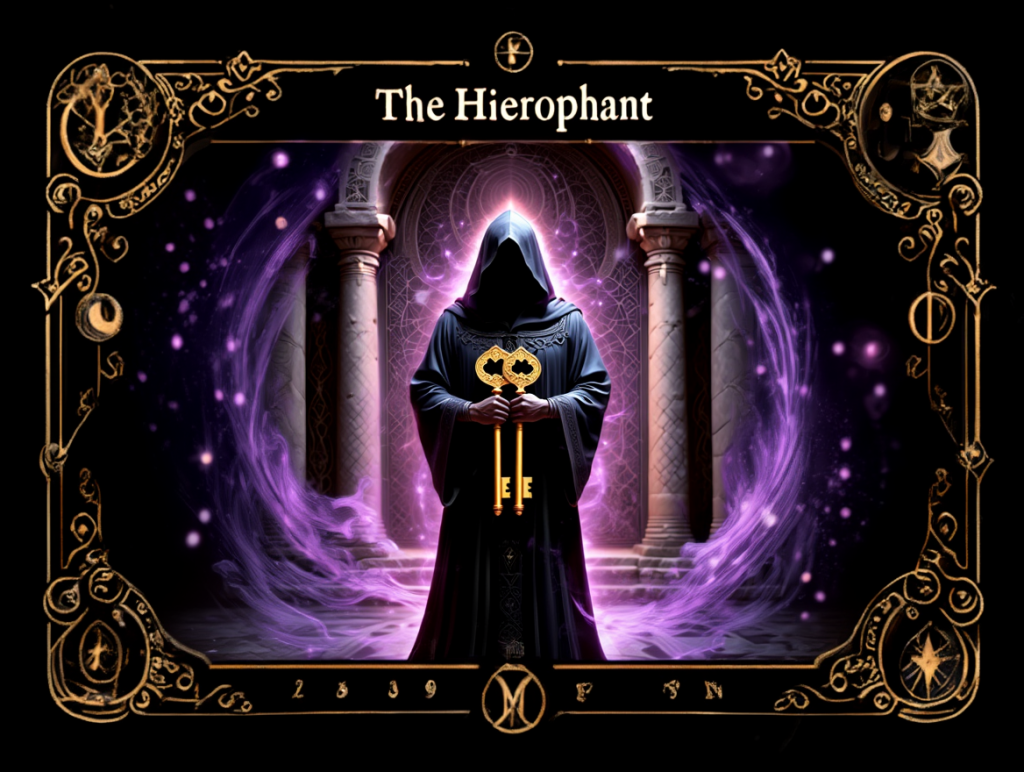
The Hierophant (card V) stands as the bridge between the divine and the human, between sacred mystery and understandable teaching, between timeless wisdom and practical application. He is the Pope, the High Priest, the Teacher, the Spiritual Guide—the one who translates eternal truths into learnable lessons.
If The High Priestess (card II) represents hidden, intuitive, mysterious wisdom accessible only through personal inner journey, The Hierophant represents revealed, teachable, traditional wisdom passed down through established lineages, sacred texts, and proven methods.
She whispers secrets meant only for you. He proclaims teachings meant for everyone ready to learn.
- . Structured learning from proven sources
- . Spiritual guidance from experienced teachers
- . Connection to tradition and established practices
- . Community support from like-minded seekers
- . Formal commitment to relationships or paths
- . Respect for what works before innovating beyond it
But here’s the paradox: The Hierophant can represent both the wisdom of established systems AND the prison of rigid dogma. He embodies both sacred tradition worth preserving AND outdated structures requiring revolution.
Your challenge: Discern which is which. Learn from tradition without becoming enslaved by it. Honor what works without worshipping it blindly.
The Hierophant Card Overview: Essential Facts
-
Card NumberV (5) in the Major Arcana
-
Alternative NamesThe Pope, The High Priest, The Teacher of Wisdom
-
KeywordsTradition, conformity, education, religion, spiritual teacher, mentor, marriage, commitment, established beliefs, sacred knowledge, orthodoxy, group membership, conventional wisdom
-
ElementEarth (Taurus—grounded spirituality, practical wisdom, material tradition)
-
Astrological AssociationTaurus—steadfast, traditional, values-driven, resistant to change, connected to earthly manifestations of the divine
-
Upright MeaningSeek traditional wisdom; learn from established teachers; honor sacred traditions; join communities of shared belief; commit formally
-
Reversed MeaningQuestion authority; reject dogma; forge your own spiritual path; break from tradition; unconventional beliefs; freedom from conformity
-
Yes or NoYES—especially for matters involving education, traditional relationships, seeking guidance, or working within established systems
Symbolism Revealed: Sacred Teachings Made Visible
The Hierophant sits in a formal religious setting, surrounded by symbols of spiritual authority and traditional wisdom.
The Two Pillars
Like The High Priestess, The Hierophant sits between two pillars—but his pillars are different:
- . Black and white (hidden mystery, intuitive wisdom)
- . Guard the veil to the unconscious
- . Represent esoteric, personal spiritual truth
- . Often both gray or both stone (established tradition)
- . Frame a formal religious institution
- . Represent exoteric, shared religious truth
- . Sometimes labeled “Law” and “Liberty” or “Obedience” and “Disobedience”
The pillars teach: Even within tradition, there is tension between following the established path (obedience/law) and personal freedom (liberty/disobedience). Wisdom lies in navigating both, not choosing one exclusively.
The Triple Crown (Papal Tiara)
- . The three worlds: Conscious, subconscious, superconscious (or physical, mental, spiritual)
- . The Holy Trinity: Father, Son, Holy Spirit (in Christian tradition)
- . Three levels of initiation: Student, practitioner, master
- . Authority over three realms: Heaven, earth, and the underworld
This crown declares: His authority extends beyond the material world into spiritual realms. He doesn’t just teach worldly knowledge—he imparts sacred wisdom connecting all dimensions.
The Triple Cross (Papal Staff)
- . The Holy Trinity (Christian symbolism)
- . Three levels of spiritual law: Divine law, natural law, human law
- . Connection between: Spirit, mind, and body
- . His role as “Pontifex”: Bridge-builder between deity and humanity
The Latin word “pontifex” literally means “bridge-builder.” The Hierophant doesn’t just teach ABOUT the divine—he creates a bridge allowing you to access it yourself.
The Hand of Benediction
The Hierophant’s right hand is raised in blessing—two fingers pointing up, two pointing down.
- . “As above, so below”: (like The Magician, connecting heaven and earth)
- . Blessing and transmission: Energy flowing from divine to human
- . The bridge: Two fingers skyward (receiving from heaven), two earthward (transmitting to humanity)
- . Balance: Honoring both spiritual and material realms
This hand position appears in countless religious artworks. It’s not arbitrary—it’s a mudra (sacred hand gesture) carrying specific energetic and symbolic meaning.
The Three Robes
The Hierophant wears three layers of robes—typically red, blue, and white:
- Red (outer): Earthly power, passion, physical realm, action
- Blue (middle): Spiritual wisdom, divine connection, higher consciousness
- White (inner): Purity, divine essence, sacred truth
The layers teach: To reach the pure divine essence (white), you must work through both spiritual wisdom (blue) and earthly reality (red). The Hierophant honors ALL levels, not just the ethereal.
The Two Acolytes/Students
- . The transmission of knowledge: Teacher to student
- . Lineage: Wisdom passed down through generations
- . Receptivity: Humble willingness to learn
- . Community: Spiritual paths often require fellow travelers
- . Dual nature: Both are needed (masculine/feminine, logic/intuition, action/receptivity)
Important: These students are NOT passive. They actively seek the teaching. The Hierophant teaches those who genuinely want to learn, not those coerced into listening.
The Crossed Keys
Often at The Hierophant’s feet lie two crossed keys—one gold (solar/masculine/conscious) and one silver (lunar/feminine/unconscious).
- . Sacred mysteries previously hidden
- . The gates between worlds (heaven and earth)
- . Your own inner temple (access to divine within)
- . Initiation into deeper levels of understanding
The keys teach: The teacher possesses keys that can unlock what you cannot access alone. But once you learn, those keys become YOURS.
The Formal Temple Setting
Unlike The Empress’s lush garden or The Emperor’s mountain throne, The Hierophant sits in a formal, structured, institutional space—a church, temple, or sacred building.
This represents:
- Established religion and organized spirituality
- Institutions preserving wisdom across generations
- Formal structures that protect sacred teachings
- Community spaces where seekers gather
The environment matters: The Hierophant doesn’t operate in wild nature or personal isolation. He works within structures, systems, and communities.
The Hierophant Upright: Learn From Those Who Came Before
When The Hierophant appears upright, he says: Don’t reinvent everything. Learn the fundamentals from proven sources FIRST. Then innovate if needed.
Seek Out Teachers and Mentors
You don’t have to figure everything out alone. Someone has already mastered what you’re trying to learn.
- . Find a teacher, mentor, or guide who’s walked your path
- . Study with those who have proven expertise, not just charisma
- . Join established educational institutions or spiritual communities
- . Learn the fundamentals before claiming mastery
- . Respect the wisdom that’s been tested across generations
Where do you need teaching right now?
- Spiritual practices you’re curious about
- Professional skills you want to develop
- Relationship dynamics you’re struggling with
- Life challenges someone wise could illuminate
The Hierophant says: Humility to admit you don’t know and seek guidance is strength, not weakness.
Honor Tradition and Proven Methods
The Hierophant doesn’t favor innovation for innovation’s sake. If something works, why fix it?
- . Religious/spiritual practices refined over millennia
- . Relationship structures that create stability (marriage, commitment)
- . Educational systems transmitting knowledge effectively
- . Healing modalities proven across cultures and centuries
- . Artistic techniques mastered by generations of practitioners
The Hierophant teaches: Learn the rules before you break them. Master the tradition before you transcend it. Understand WHY something works before you discard it.
Too many people rebel against tradition without ever understanding it. That’s not wisdom—that’s knee-jerk reactivity.
Join Communities of Shared Belief
Spiritual paths aren’t always solitary journeys. Sometimes you need fellow travelers.
- . Joining religious or spiritual communities
- . Participating in group rituals and ceremonies
- . Finding your “tribe” of like-minded seekers
- . Engaging in formal study groups or classes
- . Building relationships with people who share your values
- . Support during challenging times
- . Accountability for your practice
- . Collective wisdom greater than individual knowledge
- . Sense of belonging and shared purpose
- . Transmission of teachings requiring direct instruction
Caution: Choose communities wisely. The Hierophant at his best creates supportive fellowship. At his worst, he enables cult-like groupthink.
Make Formal Commitments
The Hierophant favors official, formal, traditional commitments over casual, ambiguous arrangements.
- . Marriage (formal, legal, ceremonial union)
- . Religious vows or initiations
- . Formal education (degrees, certifications, credentials)
- . Contractual agreements (employment, business partnerships)
- . Public declarations of values or beliefs
Why formalize?
- Clarity about expectations
- Public accountability
- Legal protections
- Deeper commitment beyond feelings
- Honoring the seriousness of the bond
The Hierophant says: If something matters, make it official. Don’t just “see where it goes”—commit intentionally.
Study Sacred Texts and Teachings
- . Religious scriptures (Bible, Quran, Torah, Bhagavad Gita, Buddhist sutras)
- . Philosophical texts (Plato, Aristotle, Kant, Eastern philosophy)
- . Esoteric teachings (Hermeticism, Qabalah, alchemy, Tarot itself)
- . Classic literature preserving cultural wisdom
- . Academic study of subjects deeply explored
The value: These texts survived centuries because they contain genuine wisdom. You don’t have to accept them dogmatically, but dismissing them without study is arrogance.
The Hierophant Reversed: Question Everything, Follow No One Blindly
When The Hierophant appears reversed, he announces: The old ways no longer serve you. Time to forge your own path.
Break Free From Limiting Dogma
The Hierophant reversed appears when tradition has calcified into oppression.
- . Religious teachings that shame rather than uplift
- . Belief systems that contradict your lived experience
- . Communities that demand conformity over authenticity
- . Teachers claiming sole access to truth
- . Institutions more concerned with power than wisdom
- . Traditions perpetuating harm in the name of “that’s how it’s done”
- . Question authority—not all who claim wisdom possess it
- . Challenge dogma—sacred texts can be reinterpreted
- . Leave toxic communities—fellowship shouldn’t require self-betrayal
- . Trust your experience over others’ doctrines
- . Create your own spiritual path outside established traditions
This isn’t rebellion for rebellion’s sake. It’s recognizing when the emperor has no clothes—when institutions claiming divine authority have lost their way.
Become Your Own Teacher
The reversed Hierophant declares: You no longer need external approval or permission.
You are ready to:
- Trust your inner guidance over external authorities
- Synthesize wisdom from multiple traditions (not just one)
- Create personalized spiritual practices
- Question everything, including what you previously accepted
- Develop your own relationship with the divine
This requires maturity. Rejecting all teachers because you think you know everything is spiritual bypassing. But recognizing you’ve outgrown certain teachings and claiming your own spiritual authority is evolution.
The test: Can you honor what traditions taught you while also moving beyond them? Can you be grateful for past teachers while also becoming your own guide?
Unconventional Relationships and Lifestyles
- . Choosing not to marry (or creating alternative commitments)
- . Polyamory or other relationship structures
- . LGBTQ+ identities in communities that don’t accept them
- . Career paths outside conventional success metrics
- . Living situations that defy social norms
- . Rejecting family expectations about how you “should” live
The reversed Hierophant says: You don’t owe conformity to anyone. Your life is YOURS to architect, not theirs to dictate.
Challenging Institutional Authority
- . Corporate hierarchies that exploit workers
- . Educational systems that stifle creativity
- . Medical establishments ignoring patient needs
- . Religious institutions covering up abuse
- . Political systems serving power rather than people
- . Any authority demanding obedience without earning trust
When do you challenge authority?
- When it causes genuine harm
- When it demands self-betrayal
- When it prioritizes control over service
- When it claims infallibility
- When it punishes dissent rather than welcoming dialogue
The Hierophant in Love: Traditional Values Meet Sacred Union
For Singles: Commitment-Oriented Connection
The Hierophant in love readings signals attraction to (or offering) serious, traditional, committed relationships.
You might be seeking:
- Someone with shared values and beliefs
- Traditional courtship rather than casual dating
- Partners from similar backgrounds or communities
- Relationships blessed by family or community
- Marriage-minded individuals
- Stable, predictable, respectable partnership
The Hierophant relationship feels:
- Safe and conventional
- Socially approved and understood
- Built on shared belief systems
- Oriented toward long-term commitment
- Respectful of tradition and family
Potential challenge: The Hierophant type might be rigid about relationship roles or uncomfortable with unconventional dynamics.
For Couples: Marriage and Formal Union
In established relationships, The Hierophant often indicates:
Positive manifestations:
- Engagement or marriage on the horizon
- Renewing vows or deepening commitment
- Shared spiritual practice strengthening the bond
- Family approval and support
- Traditional ceremonies honoring the relationship
- Building a partnership on shared values
The Hierophant marriage emphasizes:
- Sacred union beyond just legal contract
- Commitment witnessed by community
- Shared beliefs and life philosophy
- Traditional roles (if both partners agree)
- Stability and predictability
- Family legacy and continuation
Caution: The Hierophant can also indicate relationships where conformity matters more than authenticity. Are you together because you genuinely love each other, or because it’s what’s “expected”?
Reversed in Love: Non-Traditional Unions
- . Choosing unconventional relationship structures
- . Rejecting marriage or formal commitment
- . Partners from very different backgrounds/beliefs
- . Relationships family/community disapprove of
- . Breaking free from traditional gender roles
- . Creating your own relationship agreements
- . Liberating: When tradition doesn’t fit your authentic needs
- . Problematic: When fear of commitment masquerades as “non-conformity”
Ask yourself: Are you rejecting tradition because it doesn’t serve you, or because commitment scares you?
The Hierophant in Career: Education, Mentorship, Institutions
Formal Education and Credentials
- . Returning to school for degrees or certifications
- . Pursuing professional development training
- . Earning credentials that establish credibility
- . Working within academic institutions
- . Teaching roles (formal classroom instruction)
- . Following established career paths with clear advancement
- . Education (teachers, professors, trainers)
- . Religion (clergy, spiritual leaders, chaplains)
- . Law (lawyers, judges, mediators)
- . Medicine (doctors, therapists, counselors following established protocols)
- . Traditional institutions (government, established corporations)
- . Roles preserving and transmitting knowledge
Mentorship and Guidance
The Hierophant emphasizes learning from those with proven expertise:
As student:
- Seek mentors in your field
- Study under established masters
- Join professional associations
- Learn traditional methods before innovating
- Respect seniority and experience
As teacher:
- Share your expertise generously
- Mentor junior colleagues
- Preserve valuable knowledge for future generations
- Create structured learning environments
- Honor the lineage that taught you
Working Within Established Systems
The Hierophant succeeds within traditional corporate/institutional hierarchies:
- Following company procedures and protocols
- Respecting chain of command
- Working within existing structures rather than disrupting them
- Benefiting from established systems and resources
- Advancing through formal channels
When this works: You gain stability, resources, and institutional support.
When this doesn’t work: You feel stifled by bureaucracy and rigid rules.
Reversed in Career: Breaking From Tradition
- . Leaving corporate jobs to start your own business
- . Challenging outdated industry practices
- . Pursuing unconventional career paths
- . Self-directed learning over formal education
- . Disrupting established business models
- . Refusing to “play the game” of office politics
The Hierophant and Spirituality: Walking the Well-Worn Path
The Value of Established Spiritual Traditions
The Hierophant asks: Why do you think you know better than thousands of years of accumulated wisdom?
- . Teachings refined across generations
- . Practices proven to produce results
- . Community support and accountability
- . Structured paths preventing spiritual bypassing
- . Teachers who can guide through common pitfalls
- . Rituals and ceremonies with accumulated power
The Hierophant says: You don’t have to create everything from scratch. Stand on the shoulders of giants who came before you.
Finding Your Spiritual Teacher
How to choose wisely:
Good teachers:
- Embody the wisdom they teach (walk their talk)
- Empower students to find their own truth
- Welcome questions and encourage critical thinking
- Never claim to be the ONLY path to truth
- Respect students’ autonomy and boundaries
- Demonstrate genuine compassion and integrity
Bad teachers (run!):
- Demand unquestioning obedience
- Claim exclusive access to divine truth
- Use fear and shame to control followers
- Isolate students from outside perspectives
- Exploit students financially, sexually, or emotionally
- Create dependency rather than empowerment
Ritual, Ceremony, and Sacred Practice
- . Daily meditation or prayer
- . Regular attendance at religious/spiritual gatherings
- . Observing holy days and festivals
- . Participating in formal ceremonies (initiations, rites of passage)
- . Following established spiritual practices systematically
- . Creates structure supporting spiritual development
- . Connects you to lineages of practitioners
- . Builds discipline beyond fleeting inspiration
- . Marks important transitions formally
- . Accumulates power through repetition
When to Honor Tradition vs. When to Rebel
This is The Hierophant’s core teaching: Discernment.
- . It contains genuine wisdom tested across time
- . It creates supportive community and belonging
- . It provides structure helping you grow
- . It preserves valuable knowledge you’d otherwise lose
- . It connects you to something greater than yourself
- . It works for you personally, not just theoretically
- . It demands self-betrayal or denial of your truth
- . It causes genuine harm to you or others
- . It claims infallibility and punishes questioning
- . It serves those in power rather than seekers of truth
- . It contradicts your lived experience consistently
- . It’s followed blindly “because that’s how it’s always been done”
The goal: Neither worship nor reject tradition blindly. Examine it critically, take what serves, leave what doesn’t, and have the wisdom to know the difference.
How to Work With Hierophant Energy
Study with Intention
- . Religious text you’ve never explored
- . Philosophical system intriguing you
- . Esoteric practice calling to you
- . Academic subject you’re curious about
Study systematically, not superficially. Read primary sources, find qualified teachers, practice consistently, reflect deeply.
Create Personal Rituals
- . Morning meditation or prayer
- . Weekly sabbath/rest day
- . Monthly ceremonies marking lunar cycles
- . Annual celebrations honoring seasons
- . Rites of passage marking life transitions
Consistency matters more than intensity. Five minutes daily beats two hours monthly.
Find Your Teachers
Identify living teachers who inspire you:
- Whose work resonates deeply?
- Who embodies wisdom you aspire to?
- Who teaches with integrity and compassion?
- Who challenges you to grow?
Then actually study with them. Take their courses, read their books, attend their workshops, join their communities.
H3: Honor Your Lineage
Acknowledge those who taught you:
- Thank mentors who shaped your path
- Study the lineages behind teachings you value
- Pass knowledge forward to those ready to receive
- Preserve wisdom that might otherwise be lost
The Hierophant Card Combinations
-
The Hierophant + The High PriestessBalancing esoteric personal wisdom with exoteric traditional teaching. Inner knowing meets outer instruction. Both paths valid.
-
The Hierophant + The LoversSacred marriage, traditional wedding, relationship blessed by community. Choosing partnership aligned with values.
-
The Hierophant + The DevilWarning about dogma becoming addiction, tradition becoming prison. Religious control or spiritual materialism. Shadow of institution.
-
The Hierophant + The TowerEstablished institutions crumbling, religious structures collapsing. Necessary destruction of outdated belief systems. Spiritual crisis leading to breakthrough.
-
The Hierophant + JudgmentSpiritual awakening through traditional path. Calling to religious vocation. Higher truth revealed through established teaching.
-
The Hierophant + Two of CupsSacred partnership, committed relationship, blessed union. Love anchored in shared values and beliefs.
-
The Hierophant + Five of WandsConflict between tradition and innovation. Power struggles within institutions. Competing belief systems clashing.
-
The Hierophant + King of PentaclesEstablished authority, traditional success, institutional power. Mastery within conventional systems.
Final Word: The Bridge You Choose to Cross
The Hierophant doesn’t arrive by accident. He appears when you face a choice about how to learn, who to trust, and which path to walk.
The questions he raises:
Do I learn from established sources or reinvent everything myself?
Do I seek teachers or claim I already know?
Do I honor tradition or rebel against it?
Do I join communities or walk alone?
Do I commit formally or keep things casual?
Here’s the wisdom:
There is no single right answer.
Some need The Hierophant’s structured path—the safety of tradition, the support of community, the wisdom of teachers who’ve walked before them.
Others need The Hierophant reversed—the freedom to question, the courage to forge new paths, the strength to stand alone if necessary.
And most of us need BOTH at different times.
The master knows when to be student.
The rebel honors what’s worth preserving.
The traditionalist questions what no longer serves.
The Hierophant is the bridge between heaven and earth, between ancient wisdom and current application, between what was and what can be.
He doesn’t demand you cross his bridge.
He simply reminds you: bridges exist. Teachers await. Wisdom has been preserved. Communities gather. The path has been walked.
Whether you take that bridge or build your own—that’s your choice.
Just make it consciously.
With discernment.
And humility to know you don’t have all the answers alone.
The sacred is revealed to those who genuinely seek it—whether through the ancient door or a new one you courageously create.