Crowned and calm, the King of Cups sits on a stone throne in the open sea. His card means strong feeling held steady, so a person can still lead. Reversed, he goes cold or becomes the double-dealer Waite describes.
The 14th and last Cups card in a 78-card pack, he outranks the Queen. In Crowley’s 1912 printing of the Golden Dawn tarot text, the Knight ranks higher and this card is “The Prince of the Chariot of the Waters.”
| Upright keywords | Reversed keywords |
|---|---|
| Calm under pressure, fairness | Double-dealing, hidden motives |
| Kindness with authority | Coldness, withdrawal |
| Good counsel, creative intelligence | Help with strings attached |
What the card shows
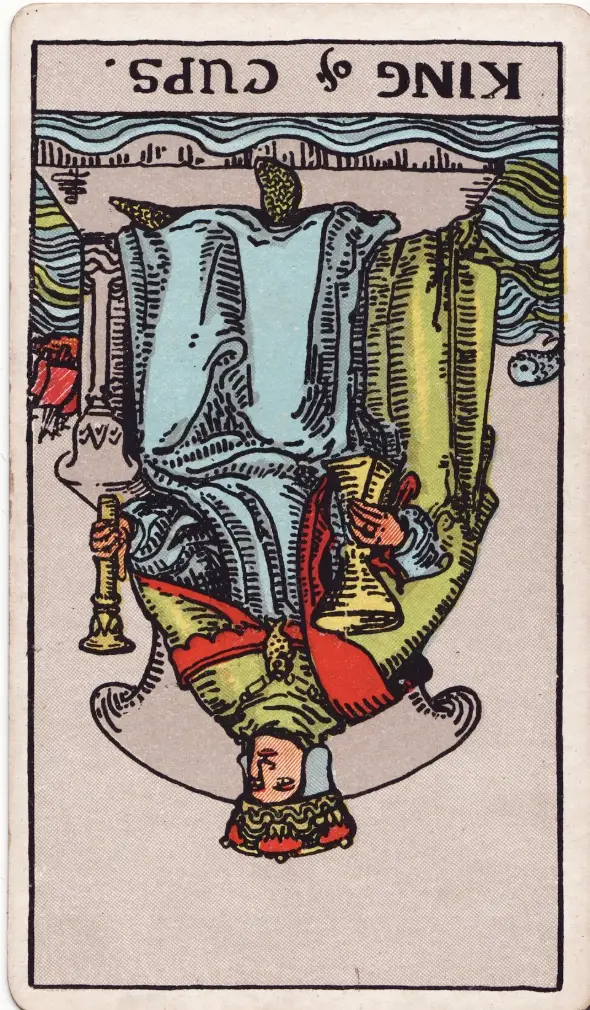
The King faces straight out from a broad stone throne that stands on the sea itself, with no shore in sight. Bands of blue and green waves run around its base. In his right hand he holds a plain gold goblet, open at the top, and in his left a short gold scepter.
His long blue robe falls to a pair of pointed shoes. Over it he wears a yellow-green cloak with a red collar, and a small gold fish hangs on a chain at his chest. On the left, a gray fish with a large round head leaps clear of the waves. On the right, a ship with a red sail rides behind the arm of the throne.
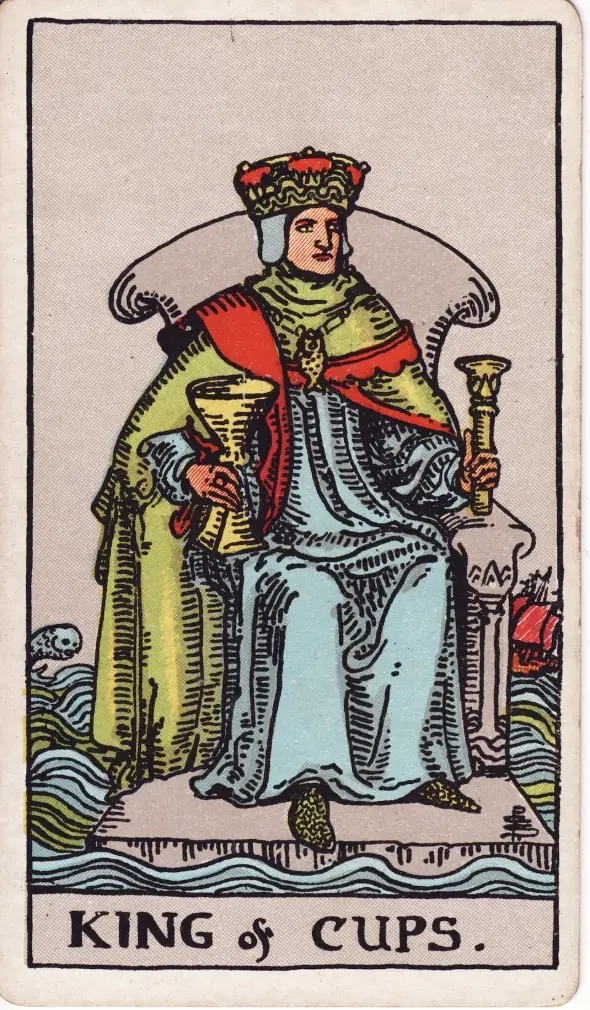
“The implicit is that the Sign of the Cup naturally refers to water”
A. E. Waite, on the picture of the King of Cups, The Pictorial Key to the Tarot (1910). Source: Wikisource, Part III, read November 20, 2026.
By his account, water appears in all four Cups court cards. The gray cap showing under the crown has a name, too. In his King of Wands entry, Waite says each of the four Kings wears a cap of maintenance beneath his crown.
The King in the Cary-Yale Visconti deck was painted by hand in the 15th century. A bearded king robed in red patterned with gold holds a long gold scepter against his shoulder, with a gray fur cap under his crown. Beside him a small boy in a green and gold tunic looks up and holds out one hand. The cup itself is worked into the patterned gold behind them.
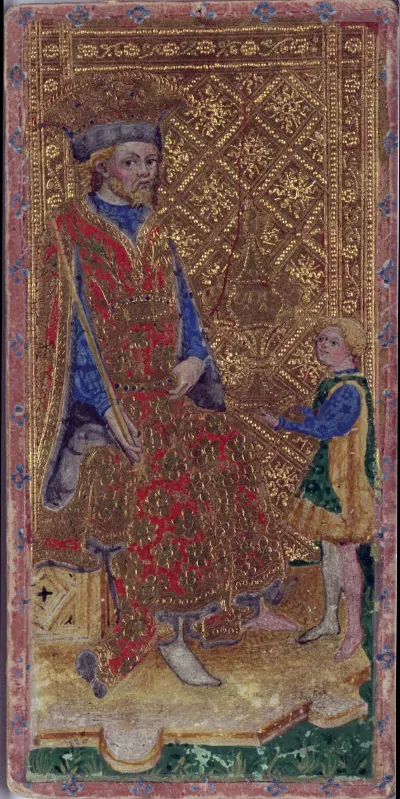
King of Cups upright
In an emotional room, the upright King keeps his head. A coach hears a player’s excuse, guesses there’s trouble at home, and deals with it without an audience. At a tense family dinner, an uncle steers the talk away from the old argument before anyone raises a voice.
“Fair man, man of business, law, or divinity; responsible, disposed to oblige the Querent”
A. E. Waite, divinatory meanings of the King of Cups, The Pictorial Key to the Tarot (1910). Source: Wikisource, Part III, read November 20, 2026.
After that he names equity, art and science, and last of all creative intelligence. This King cares and also runs things, whether that’s a gallery, a parish or a small firm.
King of Cups reversed
“Dishonest, double-dealing man; roguery, exaction, injustice, vice, scandal”
A. E. Waite, the King of Cups reversed, The Pictorial Key to the Tarot (1910). Source: Wikisource, Part III, read November 20, 2026.
In Waite’s day, exaction meant squeezing people, taking more than is fair. In a later section of additional meanings, Waite also warns of ill will from someone in high position, and of a hypocrite who poses as a helper.
It’s the boss who’s warm in your one-on-one and takes the credit in the meeting. Or a relative offers to handle your paperwork, then won’t let you see it.
He may also shut down, with feelings locked away until they leak out as sarcasm or a long, cold silence.
King of Cups in love
For single readers, this card can describe someone mature and kind, who says what they mean and doesn’t play games. It can just as well describe the calm you bring yourself.
A couple with this card argues without keeping score. Either of you can raise a complaint and get a fair hearing, so small problems stay small.
Reversed, a partner may go quiet and make you guess, or use calm as a weapon in every disagreement.
Career and work
On the job, the upright King leads people through stress. Think of the manager who holds a team together after a bad quarter, or the editor who gives hard notes kindly. Fields that mix feeling and judgment suit him.
Reversed, he keeps the smile and runs the office on private deals.
Money
Bills go out on time and something is set aside each month. He’s generous, and he budgets for that too.
For all his good sense, choosing investments isn’t part of this card. Upside down, money becomes a tool of control, like a loan that’s really a way to buy loyalty.
King of Cups as feelings
They care about you, and you’ll see it in how reliable they are more than in anything they say.
A reversed King points to someone who’s kind to you when it pays.
King of Cups as advice
Keep your voice level and decide the way you would on a calm day. People nearby will take their cue from you.
Reversed, question the motive behind any offer of help.
Yes or no
The upright King’s yes is the steady kind, and it may take its time. Reversed, count it as a no if someone has a reason they aren’t telling you.
Questions about the King of Cups
Why is the King of Cups’ throne floating on the sea?
Waite sets the throne on the sea and says water runs through every Cups court card, but he explains no further. We read the open water as feeling on all sides and the stone block as composure.
Is the King of Cups a father figure?
To many readers he is. Waite’s King is a responsible man of business, law or the church, willing to help, and fatherhood never comes up. We’d apply the card to any steady, caring authority, such as a mentor or an older friend.
Is it a fish or a dolphin on the King of Cups?
Both names are in use. Waite’s text says a dolphin is leaping, while Smith drew a creature with a big rounded head that many readers simply call a fish. Either way, it’s a sea animal breaking the surface, and we take it as a feeling coming into view.
Is the King of Cups emotionally unavailable?
He can look that way from the outside, because he feels a great deal and keeps it level. Upright, he rarely is. Coldness and withdrawal show up when the card is reversed.
Sources
- A. E. Waite, The Pictorial Key to the Tarot, London: William Rider & Son, first published 1910 (Wikisource transcribes the 1922 reprint). Public domain. Part III: the King of Cups with its picture text, divinatory and reversed meanings, the King of Wands (cap of maintenance) and the additional meanings of the Lesser Arcana: Wikisource. Read November 20, 2026.
- The Equinox, Vol. I, No. 8 (London, 1912), “A Description of the Cards of the Tarot with their Attributions”, the Golden Dawn titles of the cards (King and Knight of Cups): PDF copy. Read November 20, 2026.
- Tarot card reading, the Golden Dawn’s swap of the King and the Knight and the first open publication of its tarot document in 1912: Wikipedia. Read November 20, 2026.
- Images: King of Cups, Rider-Waite-Smith deck, card art by Pamela Colman Smith, public domain, Wikimedia Commons. King of Cups, Cary-Yale Visconti tarot, 15th century, Beinecke Rare Book & Manuscript Library, public domain, Wikimedia Commons. File pages checked November 20, 2026.
Related cards
- Previous card: Queen of Cups
- Next card: Ace of Cups
- All 78 tarot card meanings
- Free tarot reading