Somebody has just won a fight in the Five of Swords, and the card asks what that win cost. Upright, one side takes everything and loses goodwill on the way. Reversed, the fighting tends to stop, because someone apologizes or simply walks off.
In the Golden Dawn’s card descriptions, published in 1912, this one is the Lord of Defeat, and its decan symbols are Venus and Aquarius. Its suit, Swords, has 14 cards in a full tarot deck.
| Upright keywords | Reversed keywords |
|---|---|
| Conflict, winning at a cost | Making peace, backing down |
| Pride, point-scoring | Regret after a fight |
| Hostility, sore losers | Walking away, letting it go |
What the card shows
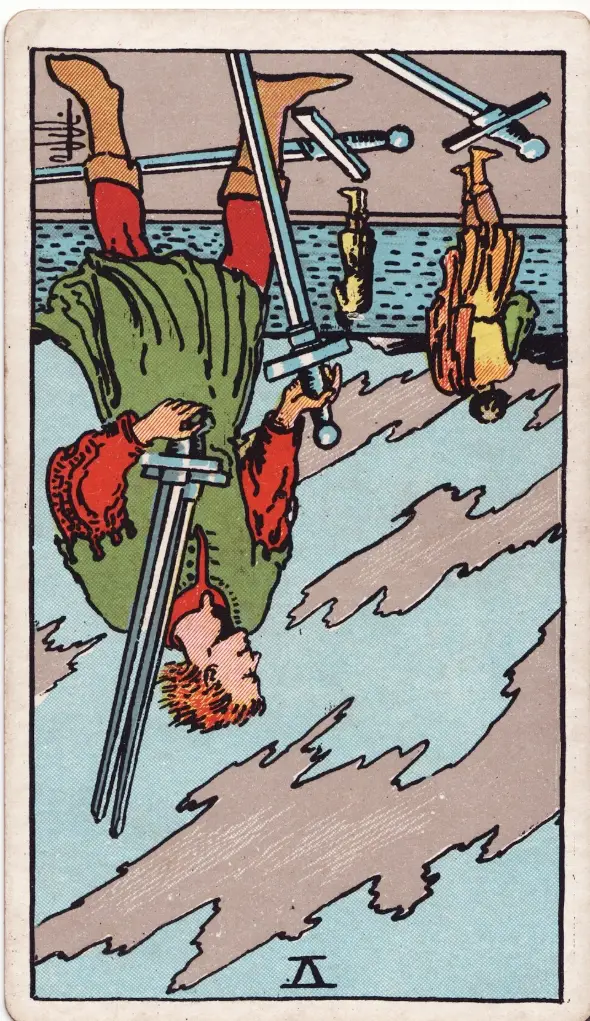
A young man with a shock of red hair stands in the foreground and glances back at the others with a thin smile. His green tunic has ragged edges and red sleeves, and his stockings are red too. He holds two swords upright against his left shoulder. His right hand rests on the pommel of a third sword, its point in the ground.
Two more swords lie at his feet. Behind him, two men walk away toward the sea. The nearer man has a red cloak slung over one shoulder, and the farther one waits by the shore with his head down. Torn gray clouds race over a light blue sky, and the sea below is choppy under a dark strip of coast.
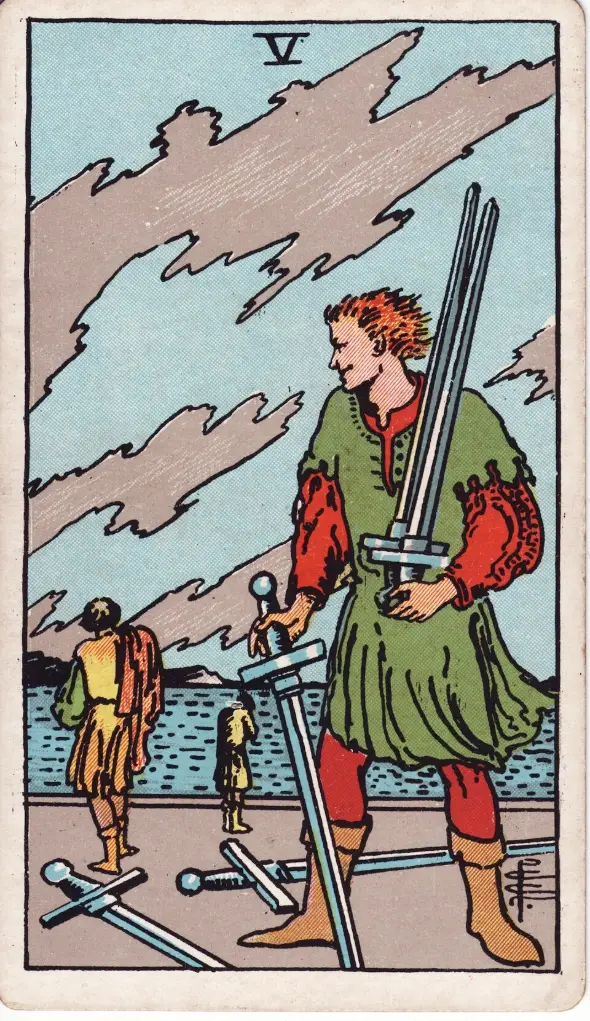
“He is the master in possession of the field.”
A. E. Waite, on the picture of the Five of Swords, The Pictorial Key to the Tarot (1910). Source: Wikisource, Part III, read November 22, 2026.
Waite calls the man disdainful and the other two “retreating and dejected.” The swords add up to five, with two on his shoulder, one under his hand and two on the ground.
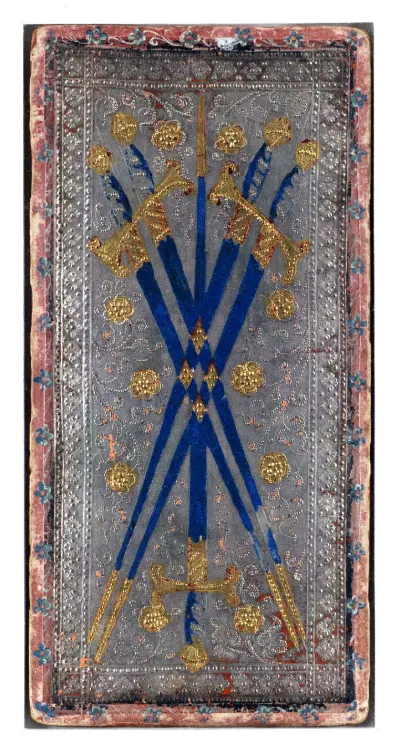
A 15th-century Five from the Cary-Yale Visconti deck has four long blue blades with gold hilts. They lean in from the top corners and cross over tooled silver. A fifth, straight blade points upward between them from a hilt near the lower edge. Smith swapped that ornament for a quarrel that has just ended.
Five of Swords upright
Someone gets their way, and everyone else goes home annoyed. At a family game night, one cousin quotes the rulebook until the others give up and fold the board. A neighbor wins the long dispute over the shared hedge, and for a year nobody on that side of the street waves back.
“Degradation, destruction, revocation, infamy, dishonour, loss, with the variants and analogues of these.”
A. E. Waite, divinatory meanings of the Five of Swords, The Pictorial Key to the Tarot (1910). Source: Wikisource, Part III, read November 22, 2026.
Most of those words describe the losing side. We look at the card from both sides, because a person who wins by any means can lose something too, such as a friend or a good name.
Five of Swords reversed
Waite answers the reversed card with “The same” and barely moves from the upright meaning. Most readers now go easier on it. The quarrel cools down, or one side decides the point isn’t worth winning.
Two roommates who have argued about dishes for months write a cleaning chart and stick it on the fridge. A runner who lost a club race by a second sends the winner a note of congratulations instead of complaining about the start.
Sometimes the reversal points instead to a grudge that outlives the fight, like a sibling who still brings up an argument from years ago.
Five of Swords in love
In a couple, the upright Five means arguments where being right matters more than being close. One partner wins the fight over a canceled vacation. The other stops raising problems at all.
Dating can turn into a contest, with each person trying to look less interested. Reversed, it points to a real apology, ideally one without a “but” attached, or to someone deciding that a relationship runs on too much conflict to continue.
Career and work
At work, the Five fits the colleague who wins every meeting and has fewer allies each month. A manager overrules every objection to a new schedule, and two of the best people ask for transfers by spring. Openly competitive settings, like a sales leaderboard or a hackathon with one prize, bring out the same streak.
If the card is upside down, a long office dispute may end in a truce, or you stop chasing a role that has turned into a fight.
Money
Someone haggles a seller at a yard sale down to almost nothing, or insists on dividing a dinner bill to the cent while the table waits.
A fresh win can make a stock trade or a mortgage choice feel easy, and neither should take its cue from this card. Reversed, you might let a small debt between friends go, because the friendship matters more to you.
Five of Swords as feelings
Upright, they may feel they won something between you, or that they lost face. Pride keeps them from admitting either.
Reversed, they probably regret how a disagreement went and want to make peace, though the first message may take a while.
Five of Swords as advice
Before the next quarrel starts, decide whether it’s one you need to win. If you’ve already won, look at what it cost and repair what you can.
Reversed, let this one go. The two men on the card have already turned their backs on the fight.
Yes or no
We answer no to the upright Five, because whatever you gain here comes with resentment attached. When it’s reversed, we’d back making peace, with some caution, but winning the original fight is still a no.
Questions about the Five of Swords
Am I the winner or the loser in the Five of Swords?
If you see yourself in the smiling man, you’re the winner, at least on paper. If you’re one of the two walking away, it can describe a loss you’re choosing to leave behind.
Can the Five of Swords mean making up after a fight?
Yes, mostly when it’s reversed. The card then points to cooling down and an agreement to drop the subject. Upright, peace looks less likely until somebody stops trying to win.
Does the Five of Swords mean the end of a friendship?
It can mean a bad falling-out, and plenty of friendships get through one. Reversed, it often ends with an apology, which lands best when both of you want the friendship back.
Sources
- A. E. Waite, The Pictorial Key to the Tarot, London: William Rider & Son, first published 1910 (Wikisource transcribes the 1922 reprint). Public domain. Part III: the Five of Swords, its picture text, divinatory meanings and the opening of its reversed entry: Wikisource. Read November 22, 2026.
- The Equinox, Vol. I, No. 8 (London, 1912), “A Description of the Cards of the Tarot with their Attributions”, item XXXIX, the Lord of Defeat (page 190): PDF copy. Read November 22, 2026.
- Images: Five of Swords, Rider-Waite-Smith deck, card art by Pamela Colman Smith, public domain, Wikimedia Commons. Five of Swords, Cary-Yale Visconti tarot, 15th century, Beinecke Rare Book & Manuscript Library, public domain, Wikimedia Commons. Both file pages checked November 22, 2026.
Related cards
- Previous card: Four of Swords
- Next card: Six of Swords
- All 78 tarot card meanings
- Free tarot reading