The Four of Swords tells you to stop for a while and rest, away from whatever has been wearing you down. Reversed, you either can’t switch off or the quiet stretches on well past the point where it helped.
Within the Swords of the Rider-Waite-Smith tarot, it is the first card set indoors. The Ace, Two and Three before it all open onto sky.
| Upright keywords | Reversed keywords |
|---|---|
| Rest taken on purpose | Can’t switch off |
| Solitude, quiet | A break gone stale |
| Watchful stillness | Thrift, close budgeting |
What the card shows
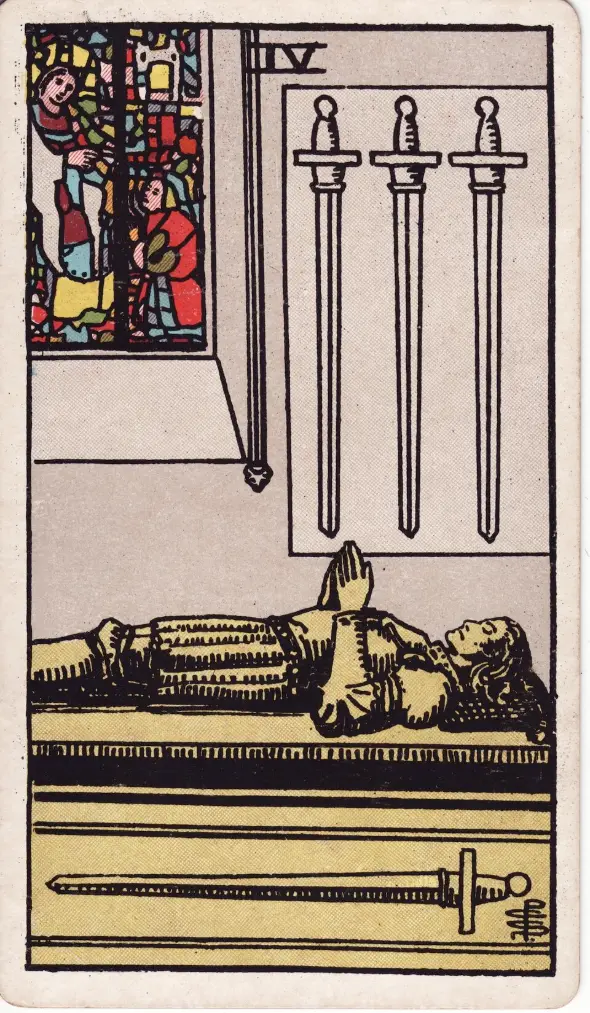
A knight rests face up on a stone tomb, eyes shut and palms pressed together over his chest. Smith painted him the pale gold of the block beneath him, so he looks carved out of it. His long hair lies loose over the chain mail at his neck.
Over him, three swords hang in a row against a pale stretch of wall, their points toward the floor. A fourth is cut lengthwise into the block itself, hilt to the right. High in the left corner, a stained-glass window shows a tall figure bending toward a smaller one wearing red.
“The effigy of a knight in the attitude of prayer”
A. E. Waite, on the Four of Swords, The Pictorial Key to the Tarot (1910). Source: Wikisource, Part III, read November 22, 2026.
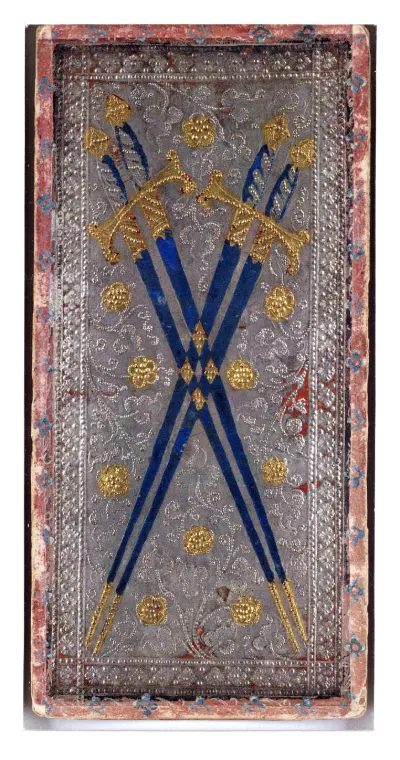
The Cary-Yale Visconti Four is thought to be the work of Bonifacio Bembo, who crossed two pairs of swords with the hilts uppermost. Small gold diamonds mark each crossing against the silver ground.
Four of Swords upright
After a move, the last few boxes stay taped shut in the hall, and you spend Saturday on the sofa. A half-knitted sweater goes into a drawer until the new year. The building’s group chat fills up with an argument about the trash schedule, and you mute it for a week.
“Vigilance, retreat, solitude, hermit’s repose”
A. E. Waite, divinatory meanings of the Four of Swords, The Pictorial Key to the Tarot (1910). Source: Wikisource, Part III, read November 22, 2026.
Waite puts vigilance ahead of retreat, so the rest on this card strikes us as alert, the kind where you’d still hear the doorbell. His phrase “hermit’s repose” points to the Hermit, whose withdrawal from the world can last a season. The Four is the shorter stay away, a matter of days or weeks.
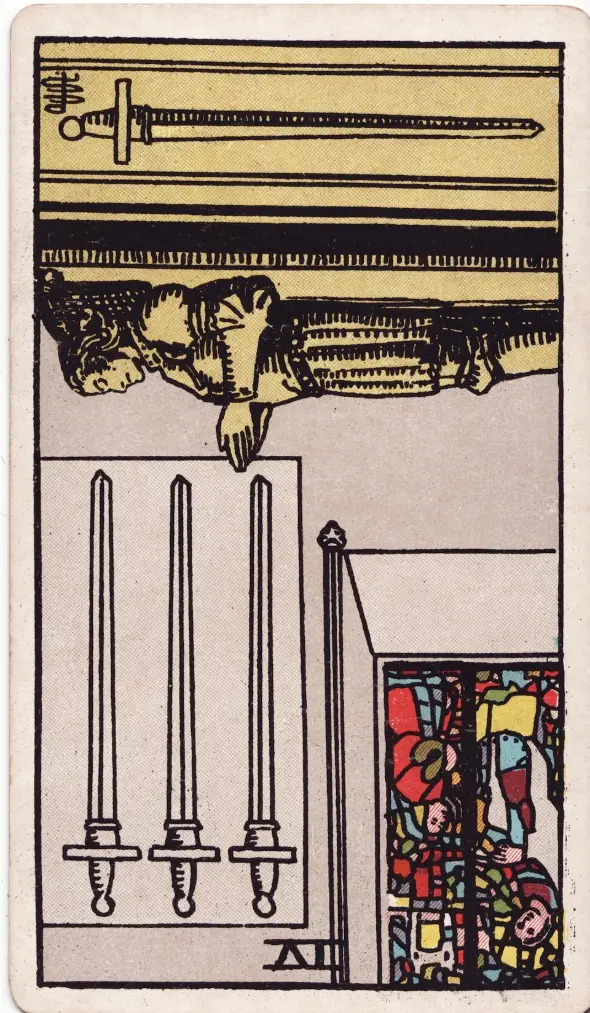
Four of Swords reversed
“Wise administration, circumspection, economy, avarice, precaution”
A. E. Waite, the Four of Swords reversed, The Pictorial Key to the Tarot (1910). Source: Wikisource, Part III, read November 22, 2026.
Waite turns the reversed Four into a card of careful management. Economy meant thrift in his day, and avarice sits at the stingy end of the same list. A friend who plans a camping trip down to the last tent peg shows the careful side. At the far end is the collector who won’t lend out one paperback from a shelf of four hundred.
We also read the reversed Four as rest that fails. You lie down for an hour and get up having planned all of next month in your head. Or the short break you promised yourself in March is still running in June, and the project you left has gone cold.
Four of Swords in love
Single, you may want a few months without meeting anyone new, even while friends keep offering to set you up. Nothing here hurries you.
Partners under strain may need quiet more than another long talk. One partner might spend a week at a sister’s place, or you agree to keep Tuesday and Thursday evenings for separate plans.
Turned over, one person keeps asking for space the other can’t give, or the time apart you agreed on has turned into two separate lives under one roof.
Career and work
In a job reading, the Four means taking the leave you’ve been saving up, or a quiet week after a deadline with an empty calendar ahead. A wedding photographer turns down one booking to keep a week clear. A teacher gets through half the summer without opening a lesson plan.
Reversed, the time off never happens. Your leave gets canceled for a meeting nobody needed, or you sit at your desk all day and finish nothing, because last week had no break in it.
Money
Once the budget is in order, the upright Four lets you leave it alone. You stop checking the balance every morning, and you stop looking up prices for things you’ve already bought.
Buying, holding or selling an investment is a different question from resting, and we leave it out when we read the Four.
In reverse, the heater stays broken all winter because paying for the repair feels wasteful.
Four of Swords as feelings
This person is running low and has pulled back to rest. Expect slower replies than usual.
Reversed, they’re restless and may get in touch sooner than you expect. Then again, they may have kept to themselves so long that reaching out now feels awkward.
Four of Swords as advice
Take a full day off, and let the people who usually reach you know you’ll be offline. Put whatever you’ve been working on somewhere out of sight until the day is over.
Reversed, end the break gently. Spend fifteen minutes on the work you stepped away from, and stop there.
Yes or no
For a rest, a leave request or a quiet weekend, the upright Four comes down on the side of yes, and against pushing hard on anything right now. Reversed, getting moving again is the yes, and more time off is the no.
Questions about the Four of Swords
Is the Four of Swords knight asleep?
He’s a likeness carved in stone, which is what Waite’s word “effigy” means. Asleep and awake don’t apply to him. We take the stillness as rest and nothing heavier.
Why are three swords hung on the wall in the Four of Swords?
Smith hung three of them up out of his reach and set the fourth into the tomb right beside him. The three could be quarrels put away for now, and the low one the matter he’ll take up first.
Where does the Four of Swords get the title Lord of Rest from Strife?
The Golden Dawn gave it that name in the tarot descriptions that The Equinox published in 1912. The same text places the card under Jupiter in Libra and says “Peace from and after war,” so the rest it means follows a struggle.
Can the Four of Swords mean a holiday?
Yes, when the trip is restful. A week at a lake cabin with a pile of books suits it well, and a tour of four cities in five days hardly at all.
Sources
- A. E. Waite, The Pictorial Key to the Tarot, London: William Rider & Son, first published 1910 (Wikisource transcribes the 1922 reprint). Public domain. Part III: the Four of Swords with its divinatory and reversed meanings: Wikisource. Read November 22, 2026.
- The Equinox, Vol. I, No. 8 (London, 1912), “A Description of the Cards of the Tarot with their Attributions”: the table of the numbered cards and the Lord of Rest from Strife: PDF copy. Read November 22, 2026.
- Tarot card reading, the Golden Dawn’s tarot text and its publication in The Equinox in 1912: Wikipedia. Read November 22, 2026.
- Images: Four of Swords, Rider-Waite-Smith deck, card art by Pamela Colman Smith, 1910, public domain, Wikimedia Commons. Four of Swords, Cary-Yale Visconti tarot, 15th century, Beinecke Rare Book & Manuscript Library, public domain, Wikimedia Commons. Both file pages read November 22, 2026.
Related cards
- Previous card: Three of Swords
- Next card: Five of Swords
- All 78 tarot card meanings
- Free tarot reading