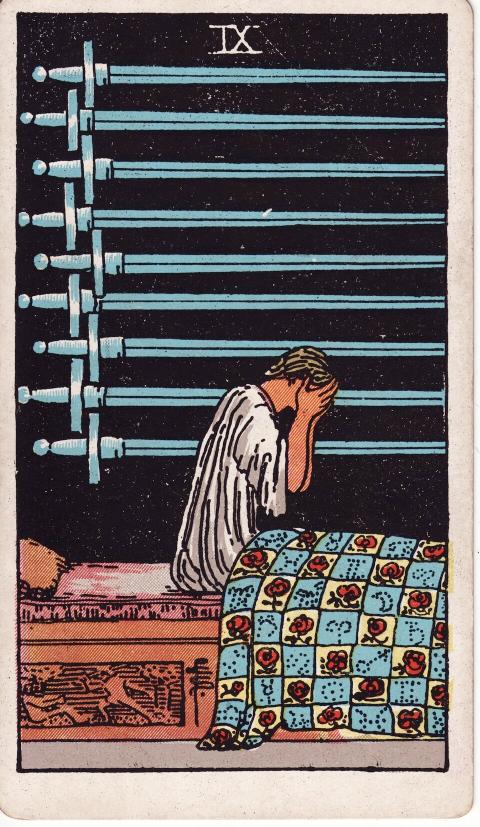
The Swords cover what goes on in your head and what comes out of your mouth. In a reading they point to decisions, arguments, plain truths and worry, and several of the pictures are hard to look at. The Three of Swords puts three blades through a heart.
Swords shares a tarot deck of 78 cards with three other suits, Cups, Wands and Pentacles. Both Etteilla and Samuel Liddell MacGregor Mathers paired it with Spades from the French pack. Its element is air.
Swords card keywords and Golden Dawn titles
| Card | Upright keywords | Golden Dawn title |
|---|---|---|
| Ace of Swords | A clear idea, plain truth, a firm decision | Root of the Powers of Air |
| Two of Swords | A decision on hold, an uneasy truce, guarded feelings | Lord of Peace Restored |
| Three of Swords | Heartbreak, sorrow, a falling-out | Lord of Sorrow |
| Four of Swords | Rest, a pause, time alone | Lord of Rest from Strife |
| Five of Swords | Conflict, winning at a cost, pride | Lord of Defeat |
| Six of Swords | Moving on, calmer waters ahead, travel | Lord of Earned Success |
| Seven of Swords | Secrecy, strategy, shortcuts | Lord of Unstable Effort |
| Eight of Swords | Feeling stuck, restriction, waiting for permission | Lord of Shortened Force |
| Nine of Swords | Worry at night, regret, fear bigger than the facts | Lord of Despair and Cruelty |
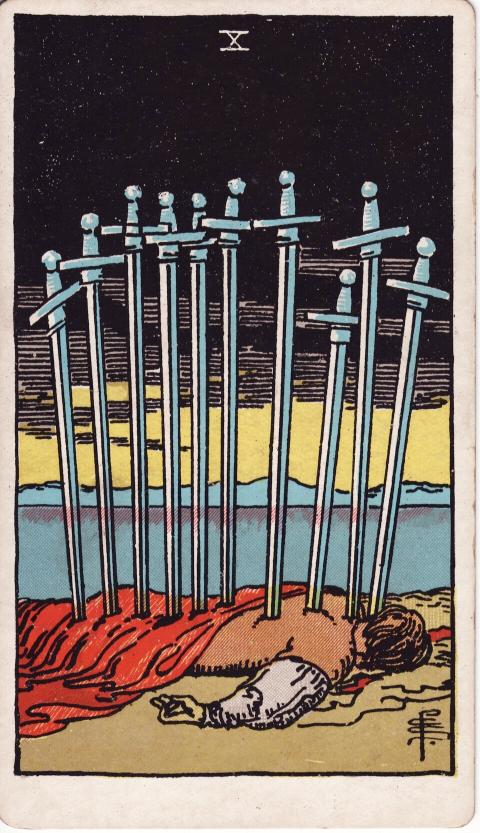
| Ten of Swords | An ending, a low point reached, letting go | Lord of Ruin |
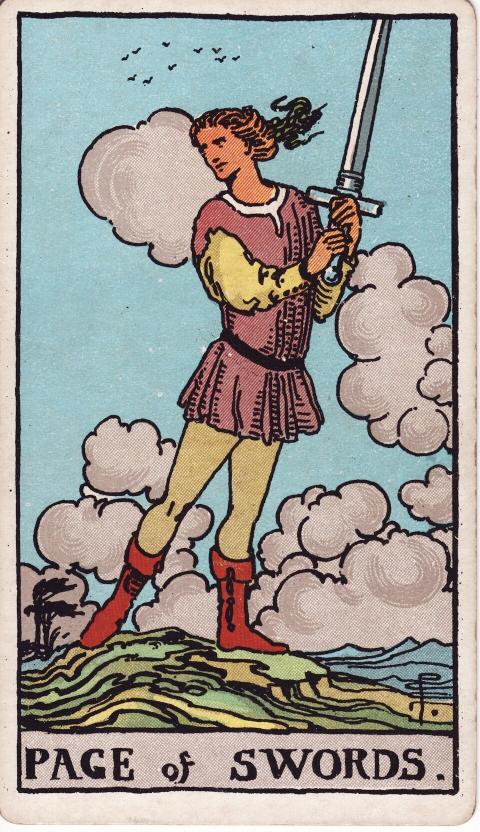
| Page of Swords | Curiosity, alertness, study | Princess of the Rushing Winds, the Lotus of the Palace of Air |
| Knight of Swords | Speed, directness, courage | Lord of the Wind and the Breezes, the King of the Spirits of Air |
| Queen of Swords | Honest judgment, firm limits, wisdom from hard times | Queen of the Thrones of Air |
| King of Swords | Fair judgment, earned authority, clear speech | Prince of the Chariot of the Winds |
Where the link to air comes from
The Golden Dawn supplied the element. Waite and the deck’s artist, Pamela Colman Smith, were both members of that occult order, yet the words air and wind do not appear in Waite’s own Swords entries.
The order’s card text first appeared in open print in 1912, in a journal called The Equinox. Air is named in the Ace’s title there, and air or wind in the title of every court card.
The court titles also show the Golden Dawn’s swap of King and Knight. In the table above, the Knight of Swords is a king of air spirits and the King of Swords is a prince.
Waite’s view of the suit
Waite’s one general warning about the suit comes in the entry for the Two, since his chapter on the minor cards gives the Swords no opening note. There he asks readers to take that card’s favorable meanings with caution:
“as Swords generally are not symbolical of beneficent forces in human affairs”
A. E. Waite, the Two of Swords, The Pictorial Key to the Tarot (1910). Source: Wikisource, Part III, read November 22, 2026.
He sums up the Wands in passing too, as “a suit of life and animation,” inside the Queen of Wands entry.
Most of his other Swords meanings fit the warning. Delay is listed for both the Three and the Nine, and the Five’s list opens with “Degradation, destruction, revocation.” Later tarot writing tied the suit to intellect as well as to sorrow and misfortune.
Twos and Fours in all four suits
Every number turns up four times in the deck, once in each suit. With the Twos, the four pictures have little in common.
In the Two of Swords, a woman with a blindfold balances a blade on each shoulder. A young couple pledge each other on the Two of Cups. On the Two of Wands, a man on a battlement holds a globe. The dancer on the Two of Pentacles keeps two pentacles in play on an endless cord.
Waite’s lists for the Two of Swords and the Two of Cups share two words, friendship and concord. For the Swords he adds that the concord holds “in a state of arms.”
The Fours slow things down. The Four of Swords has a carved knight lying in prayer, and Waite lists “hermit’s repose” for it. Repose turns up again in his meanings for the Four of Wands, where two women raise flowers under a garland near a manor house.
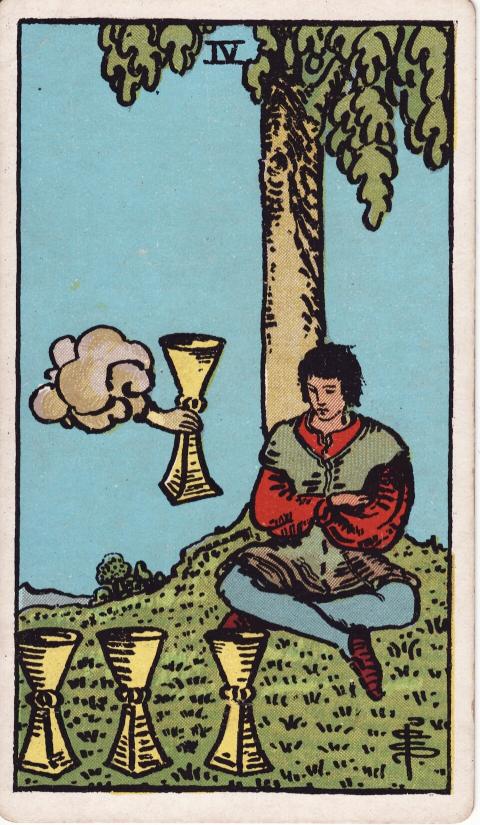
A discontented young man under a tree ignores the cup he is offered in the Four of Cups. The crowned figure on the Four of Pentacles holds tight to what he has.
Waite also printed a table for numbers that repeat within one deal. Four Twos meant “contention” to him and two Twos “accord.” Three Fours were “a subject of reflection.”
In a free card draw, a Four of Swords usually means rest, and a Four of Pentacles means holding on.
Swords court cards as people
The Page of Swords walks over rough ground with his sword held up, glancing about as if trouble could appear at any moment. His Knight rides flat out, as though scattering enemies.
In Waite’s description, the Queen of Swords has a severe face that “suggests familiarity with sorrow.” The King of Swords “sits in judgment,” and Waite compares him to Justice among the trumps.
To pick a court card for a real person, Waite went by coloring. Swords were for people with “hazel or grey eyes, dark brown hair and dull complexion.” The darkest coloring went to Pentacles, but he let an energetic person with very dark looks take a Sword card instead.
Questions about the Suit of Swords
Which zodiac signs go with the Suit of Swords?
Swords go with the air signs, Gemini, Libra and Aquarius. The Golden Dawn’s decan table gives Libra the Two to the Four, Aquarius the Five to the Seven and Gemini the Eight to the Ten. The Ace and the four courts sit outside that sequence.
Are there any good cards in the Suit of Swords?
Upright, the Ace brings a clear idea and the Six a move toward calmer water. The Four offers a rest, and the King stands for fair judgment.
Do Swords cards in a love reading mean a breakup?
A single Swords card is weak evidence for a breakup. In love questions the suit is usually about words, spoken or held back. The Two can mean guarded feelings and the Three a painful falling-out. Reading either one as an ending takes support from other cards in the spread.
Sources
- A. E. Waite, The Pictorial Key to the Tarot, London: William Rider & Son, first published 1910 (Wikisource transcribes the 1922 reprint). Public domain. Part III: the Swords entries from King to Ace, the Twos and Fours of the other suits, the Queen of Wands (“a suit of life and animation”), “The Recurrence of Cards in Dealing”, and “An Ancient Celtic Method of Divination” (court card coloring): Wikisource. Read November 22, 2026.
- The Equinox, Vol. I, No. 8 (London, 1912), “A Description of the Cards of the Tarot with their Attributions”, the titles of the Swords cards and the decan table, journal pages 147 to 149: PDF copy. Read November 22, 2026.
- Tarot card reading, Book T and its publication in The Equinox, the Golden Dawn’s swap of King and Knight, decans for the cards from 2 to 10, Smith as a Golden Dawn member: Wikipedia. Read November 22, 2026.
- Suit of swords, air, intellect, sorrow and misfortune, and Etteilla and Mathers matching Swords with Spades: Wikipedia. Read November 22, 2026.