Upright, the Three of Swords describes sorrow you can name, like a heartbreak or a falling-out with someone close. Reversed, that sorrow goes quiet, either pushed down where no one sees it or slowly easing as you make sense of what happened.
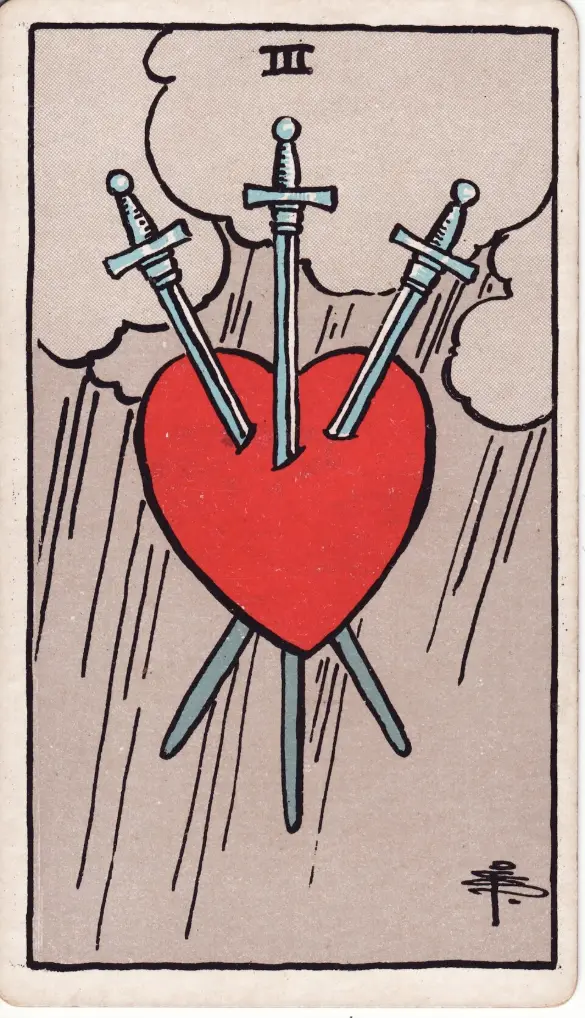
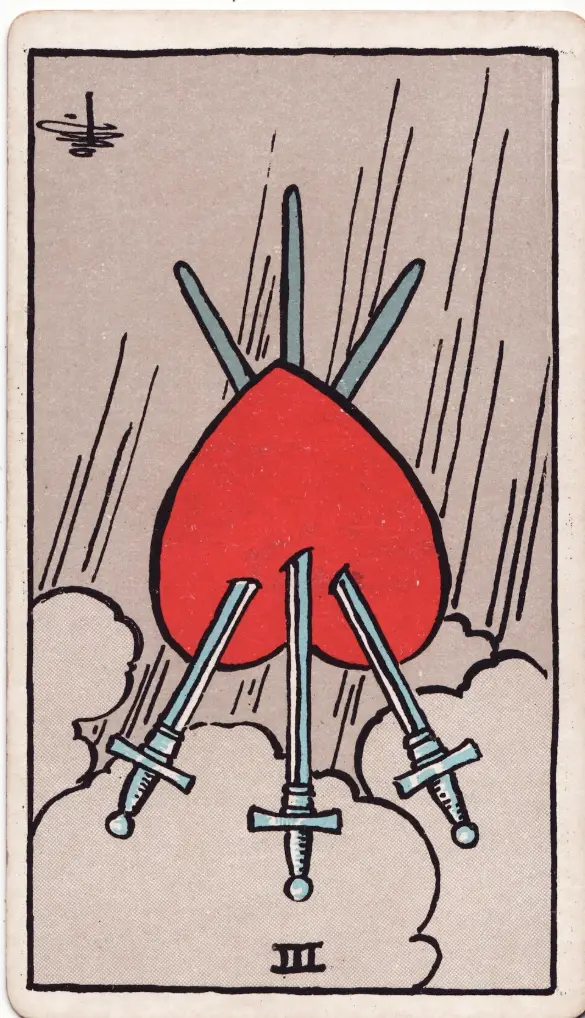
It shows a heart under three blades and a rainy sky. Every other Swords card, out of fourteen in the 78-card deck, has a person on it or at least a hand.
| Upright keywords | Reversed keywords |
|---|---|
| Heartbreak, sorrow | Hurt kept quiet |
| A hard truth | Sorrow starting to ease |
| A falling-out | Confusion, mixed feelings |
What the card shows
Pierced from above by three swords, a big red heart floats in a gray sky. It’s drawn as the plain shape from a valentine card. One sword slants in from the left, one drops straight down the middle and one tilts down from the right.
Their points come out under the heart, and their pale blue hilts with round pommels stay above it. Gray clouds bank up behind the hilts, and thin lines of rain slant across the background on both sides. There’s no ground and no horizon.
“Three swords piercing a heart; cloud and rain behind.”
A. E. Waite, on the Three of Swords, The Pictorial Key to the Tarot (1910). Source: Wikisource, Part III, read November 22, 2026.
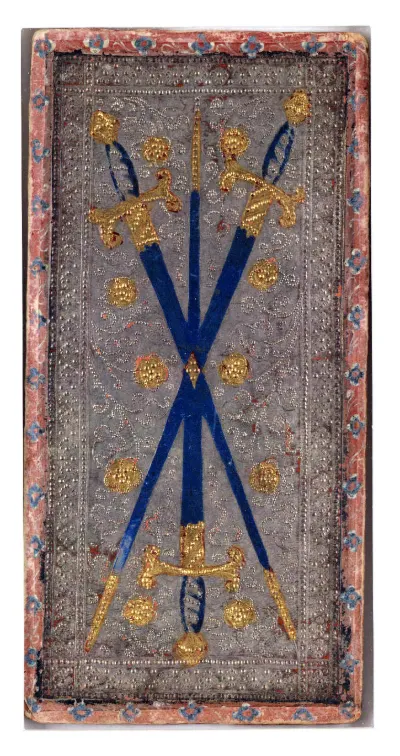
The Cary-Yale Visconti painter crossed two swords hilt-up and ran a third straight through them the other way, with its hilt pointing down. The Golden Dawn description is not far from that layout. In its version, a central sword has “struck apart” two crossed ones and cut through a rose, whose petals are falling.
Three of Swords upright
Your closest friend moves across the country, and the goodbye at the airport is harder than you expected. You overhear what your sister really thinks of your choices. A band you’ve played in for six years splits after one argument in the rehearsal room.
“Removal, absence, delay, division”
A. E. Waite, divinatory meanings of the Three of Swords, The Pictorial Key to the Tarot (1910). Source: Wikisource, Part III, read November 22, 2026.
Two words later Waite stops listing, because the meaning of the design is “too simple and obvious to call for specific enumeration.” The Golden Dawn’s table adds a title, “Lord of Sorrow”, and places the card in the Saturn decan of Libra.
Three of Swords reversed
Upside down, Waite’s meanings drift toward error and confusion, the muddled thinking that can follow bad news.
Writers after Waite look instead at how you carry the hurt. You tell everyone you’re fine after the move, then cry in the car. Months after a falling-out, you can say your old friend’s name without your voice changing.
Three of Swords in love
In love readings, the card describes hurt that has already happened or is happening now, such as a breakup or words in an argument that can’t be taken back. Nothing in it forecasts that a relationship will end.
A single person may still carry an old heartbreak into new dates, where nobody quite lives up to the person who left.
Reversed, it can be the evening you finally talk through what hurt, or the week you stop checking an ex’s profile because it’s really over.
Career and work
The Three can show up at work as a disappointment that stings. A project you cared about gets canceled, or feedback lands much harder than it was meant.
Reversed, confusion adds to the hurt, as when the reason for the cut never reaches you.
Money
You may spend to cheer yourself up, like ordering takeout every night for ten days after a breakup.
Big money decisions are better made once the sadness eases, and the card won’t make them for you.
In reverse, you notice the sad-day spending and put a limit on it.
Three of Swords as feelings
They’ve been hurt, possibly by you, possibly by something older than your time together. They may hide it well.
Reversed, the hurt has begun to fade on their side.
Three of Swords as advice
Let yourself be sad about it for a while. Describe what happened to a friend, in plain words.
Reversed, put on paper what you haven’t said to anyone, and keep the page for yourself.
Yes or no
Upright, the answer is no, especially to patching things up in a hurry. Reversed, there’s room for a yes on talking things over or moving on.
Questions about the Three of Swords
Why is it raining on the Three of Swords?
Waite mentions the cloud and rain without explaining them. The rain is most often taken as tears, which is our reading too, though a few readers see feelings finally coming out after being held in.
Is the Three of Swords always about heartbreak?
Romance is only one possible cause. Grief over a friendship, a family rift or a plan you had to give up can show up here as well, and the 1912 Golden Dawn description lists separation and quarreling among its meanings.
What does the Three of Swords mean in the past position?
There it usually points to an old hurt that still shapes how you act now. We’d ask what that earlier heartbreak taught you to avoid, and if that lesson still helps.
Sources
- A. E. Waite, The Pictorial Key to the Tarot, London: William Rider & Son, first published 1910 (Wikisource transcribes the 1922 reprint). Public domain. Part III: the Three of Swords with its divinatory and reversed meanings: Wikisource. Read November 22, 2026.
- The Equinox, Vol. I, No. 8 (London, 1912), “A Description of the Cards of the Tarot with their Attributions”: the table of the numbered cards and the Lord of Sorrow: PDF copy. Read November 22, 2026.
- Tarot card reading, the Golden Dawn’s tarot text and its publication in The Equinox in 1912: Wikipedia. Read November 22, 2026.
- Images: Three of Swords, Rider-Waite-Smith deck, card art by Pamela Colman Smith, 1910, public domain, Wikimedia Commons. Three of Swords, Cary-Yale Visconti tarot, 15th century, Beinecke Rare Book & Manuscript Library, public domain, Wikimedia Commons. Both file pages read November 22, 2026.
Related cards
- Previous card: Two of Swords
- Next card: Four of Swords
- All 78 tarot card meanings
- Free tarot reading