When she appears upright, the Queen of Swords describes honest judgment and firm limits, kept by someone who has known sorrow and come through it clear-eyed. Upside down, that edge can turn into spite, narrow-mindedness or a well-hidden lie.
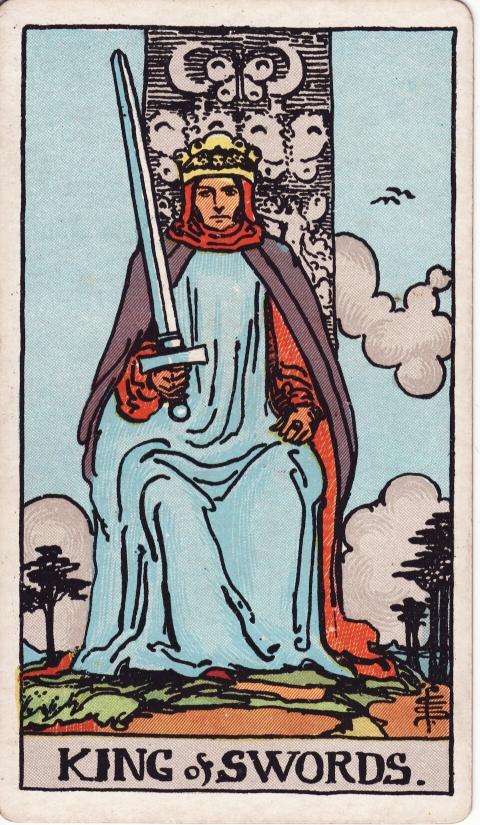
Counting the Swords from the Ace up, she is 13th of 14, between the Knight and the King, in a tarot pack of 78.
| Upright keywords | Reversed keywords |
|---|---|
| Honest judgment, clarity | Spite, harsh words |
| Firm limits, independence | Prejudice, rigid rules |
| Wisdom from hard times | Deceit, quiet grudges |
What the card shows
Smith draws her side-on, facing right, on a high-backed throne of pale gray stone. Her right hand holds a sword straight up, its hilt resting on the chair’s armrest. She lifts her left arm with the hand open, palm up, and a dark tassel hangs from a red band at her wrist.
Her gold crown is made of small butterflies. A red veil falls behind her dark curls, and over a gray gown she wears a blue cloak printed with white clouds. The throne’s side carries a carved child’s face framed by wings, with crescent shapes below it.
Behind her, a low line of white clouds stretches across the background, and one bird flies high in the clear sky above them.
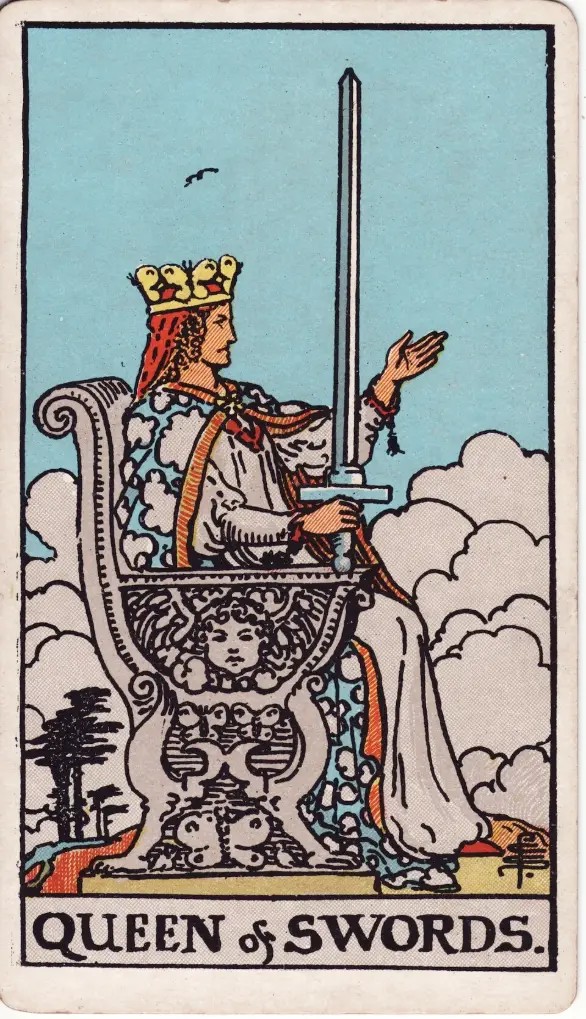
“her countenance is severe but chastened; it suggests familiarity with sorrow”
A. E. Waite, on the picture of the Queen of Swords, The Pictorial Key to the Tarot (1910). Source: Wikisource, Part III, read November 22, 2026.
We take “chastened” to mean a sternness that hard experience has softened a little.
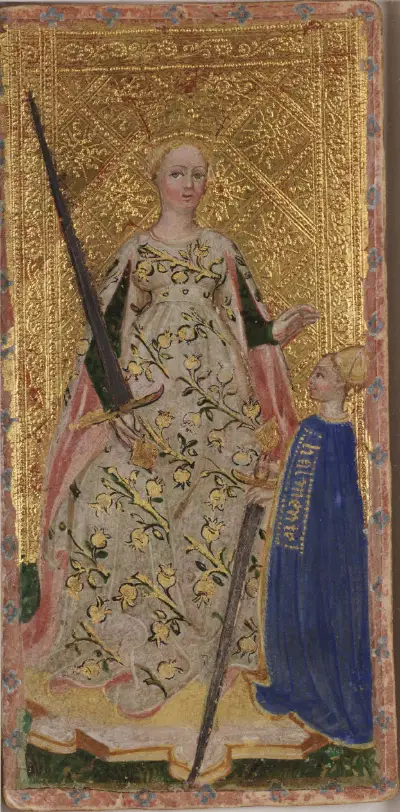
Long before Smith, a painter of the Cary-Yale Visconti tarot showed this queen standing up. Gold sprigs of fruit and leaves cover her pale gown, and she holds a long dark sword slanted up past her shoulder. A much smaller figure in a blue robe, gold letters running down its front, looks up at her and holds a second sword point down.
Queen of Swords upright
A friend reads your business plan, tells you which numbers don’t add up and then stays to help fix them. At a residents’ meeting, she has read the new parking rules in full and points to the clause about bikes in the hallway. On a group trip, she checks the visa rules and vetoes the cheap flight with a 40-minute layover.
“her sword notwithstanding, she is scarcely a symbol of power”
A. E. Waite, describing the Queen of Swords, The Pictorial Key to the Tarot (1910). Source: Wikisource, Part III, read November 22, 2026.
Her authority comes from seeing straight. The crown adds little to it. Waite’s divinatory meanings for her are heavy ones, mostly sadness, absence, privation and separation. We read that list as the past she brings to every judgment, which is why her advice tends to be practical.
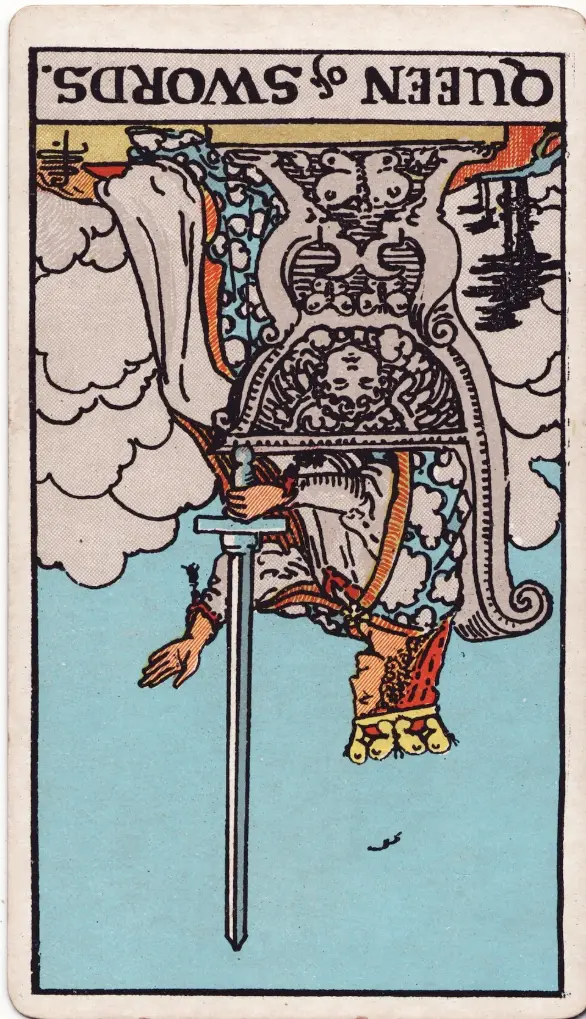
Queen of Swords reversed
“Malice, bigotry, artifice, prudery, bale, deceit.”
A. E. Waite, the Queen of Swords reversed, The Pictorial Key to the Tarot (1910). Source: Wikisource, Part III, read November 22, 2026.
Bale, a word almost nobody uses now, means evil or the misery it causes. Here her candor is used to hurt. A sister-in-law keeps a mental file of everyone’s mistakes and reads from it at every holiday. Someone in the group chat calls each dig “just being honest.”
Malice can be quiet too, like an online review of a friend’s bakery that is accurate in every detail and written to sting.
Prudery and bigotry become rules for everyone else. A neighbor reports the family next door for drying laundry on the balcony, then greets them warmly on the stairs.
Queen of Swords in love
Anyone meeting new people can take her as a reminder to know what they will and won’t accept, and to say so early. A first date who’s rude to the waiter doesn’t get a second one.
Already together, you talk straight about the things couples tend to dodge, like who covers which bills or why a joke at dinner stung.
Reversed, a partner turns sarcastic whenever they feel exposed, or keeps secrets while demanding the whole truth from you.
Career and work
A vague answer costs time or money in grant reviewing, translation or quality inspection, so she does well in that kind of work. As a team lead, she gives feedback in writing, with examples. People may find her blunt, then notice that her notes were right. In a job interview, she asks the question you hoped to avoid, and her reference letters are honest about weak spots.
At work, a reversed Queen nitpicks a project into a standstill, or holds back praise on purpose.
Money
She reads the terms before signing up and keeps her receipts. No card can price a share or pick a fund, this one included.
Reversed, she turns petty about money, chasing a friend for four dollars from a shared taxi or refusing on principle to lend anything to anyone.
Queen of Swords as feelings
This person sees you as you are, flaws included, and respects what they see. They won’t gush. Their compliments are sincere.
Reversed, they may say all the right things while thinking much less of you.
Queen of Swords as advice
Put what you mean into one sentence, then let the silence do some work. When a friend wants your opinion, give it once and leave the decision with them.
Reversed, ask yourself if your honesty is helping anyone or only letting off steam.
Yes or no
Upright, her yes goes to telling the truth or turning down a bad offer. Upside down, her answer is no if you’re hoping to settle a score.
Questions about the Queen of Swords
Why does the Queen of Swords look so sad?
Waite says her face suggests familiarity with sorrow but never names the cause. To us it reads as experience that has made her wiser and harder to fool. It speaks about a person’s history and doesn’t predict a loss for you.
Why is the Queen of Swords holding up her hand?
In our reading she’s inviting you to speak plainly, as a greeting or an offer to hear you out, since her sword stays upright and still. A signal to stop is the other usual interpretation. Waite describes no more than the raised left arm and the extended hand.
Is the Queen of Swords about setting boundaries?
Often, yes, for readers today. The picture supports it, with her straight back, a raised sword and a hand held up between her and whoever comes near. We’d suggest stating a limit calmly, once, and then keeping it.
Sources
- A. E. Waite, The Pictorial Key to the Tarot, London: William Rider & Son, first published 1910 (Wikisource transcribes the 1922 reprint). Public domain. Part III: the Queen of Swords with its picture text, divinatory and reversed meanings, and the additional meanings of the Lesser Arcana: Wikisource. Read November 22, 2026.
- Bale, noun, the sense of evil and woe: Wiktionary. Read November 22, 2026.
- Queen of Swords, the butterflies of the crown in the Rider-Waite-Smith picture: Wikipedia. Read November 22, 2026.
- Images: Queen of Swords, Rider-Waite-Smith deck, card art by Pamela Colman Smith, public domain, Wikimedia Commons. Queen of Swords, Cary-Yale Visconti tarot, 15th century, Beinecke Rare Book & Manuscript Library, public domain, Wikimedia Commons. File pages checked November 22, 2026.
Related cards
- Previous card: Knight of Swords
- Next card: King of Swords
- All 78 tarot card meanings
- Free tarot reading