Happiness that has settled in, at home and among the people you count as family, is the subject of the Ten of Cups. Upright, it’s belonging without effort. Reversed, the picture cracks, and a household looks happier from the street than it feels from the kitchen table.
It closes the numbered Cups, the last pip card before the suit’s four court cards, out of 78 cards in all. Its Thoth attribution is Mars in Pisces, the sign’s closing decan.
| Upright keywords | Reversed keywords |
|---|---|
| Happiness at home | A picture-perfect front |
| Family, chosen family | Household quarrels |
| Belonging, shared joy | Different visions of home |
What the card shows
A rainbow arches across a pale blue sky, banded pink and yellow, and ten gold cups ride along its curve. Under it, a man and a woman stand with their backs to us and look up. His arm circles her waist. He lifts his free arm toward the rainbow and she raises hers on the other side, so between them they frame it.
He wears a red tunic, pale blue breeches and white boots with red cuffs. Her blue gown trails a deep red hem on the ground.
Off to the right, two small children hold hands and dance in a ring, one dressed in red and one in blue. Beyond the family, a river bends through green fields toward a cottage with a red roof on a low hill.
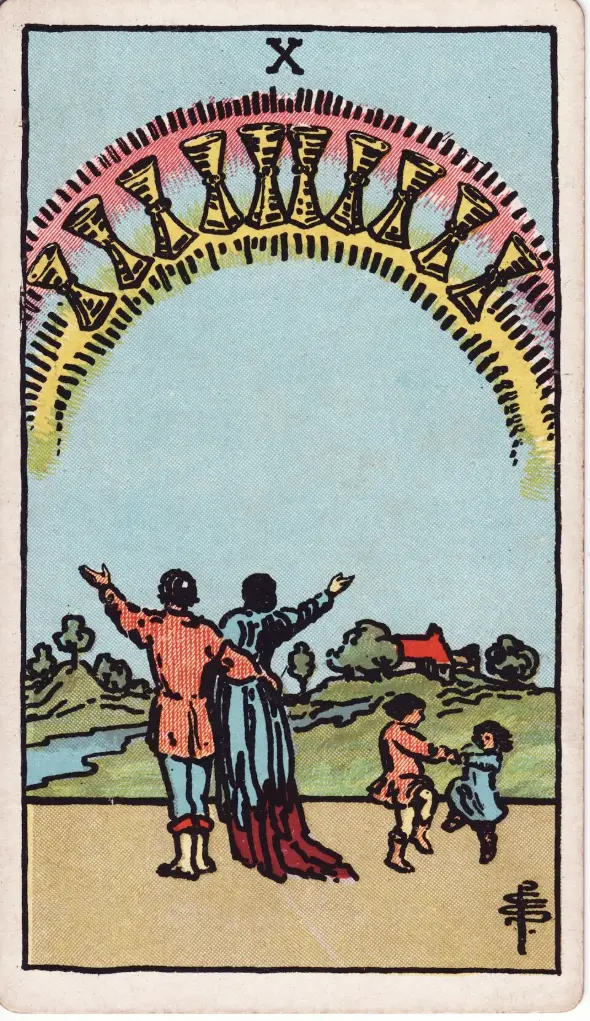
“The two children dancing near them have not observed the prodigy”
A. E. Waite, on the picture of the Ten of Cups, The Pictorial Key to the Tarot (1910). Source: Wikisource, Part III, read November 20, 2026.
He adds that they’re happy anyway. The adults look up at the sign in the sky, and the kids carry on with their game.
The Cary-Yale Visconti tarot of 15th-century Milan stacks nine of its cups in three rows of three. The tenth lies on its side across the top, as if there were no room left to stand it up.
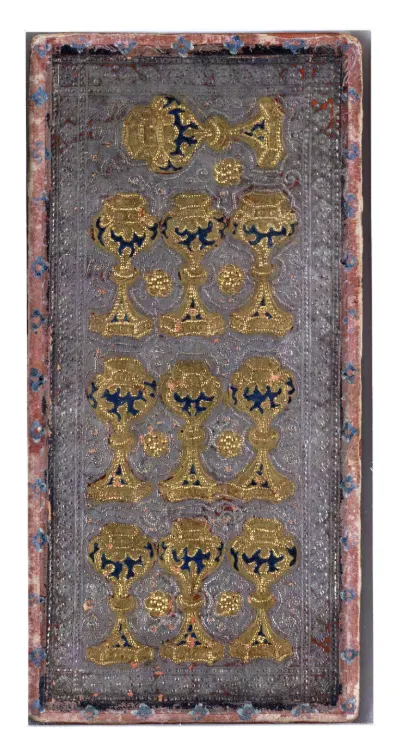
Ten of Cups upright
Upright, the Ten describes an ordinary evening that feels complete. Housemates who met through a rental listing now keep a standing Sunday dinner. A blended family finishes its first road trip with everyone still talking to each other. The last moving box goes out to the curb, and the new place finally smells like yours.
“Contentment, repose of the entire heart; the perfection of that state”
A. E. Waite, divinatory meanings of the Ten of Cups, The Pictorial Key to the Tarot (1910). Source: Wikisource, Part III, read November 20, 2026.
His list carries on into human love and friendship. Next to several court cards, he says, the Ten can be a person looking after your interests, and it can even stand for the town or village you live in. That makes the card wider than a wedding photo. Any circle where you can stop performing and simply belong fits it.
The word heart ties the two ends of the suit together. Waite’s Ace is the “house of the true heart”, and his Ten is the whole heart at rest.
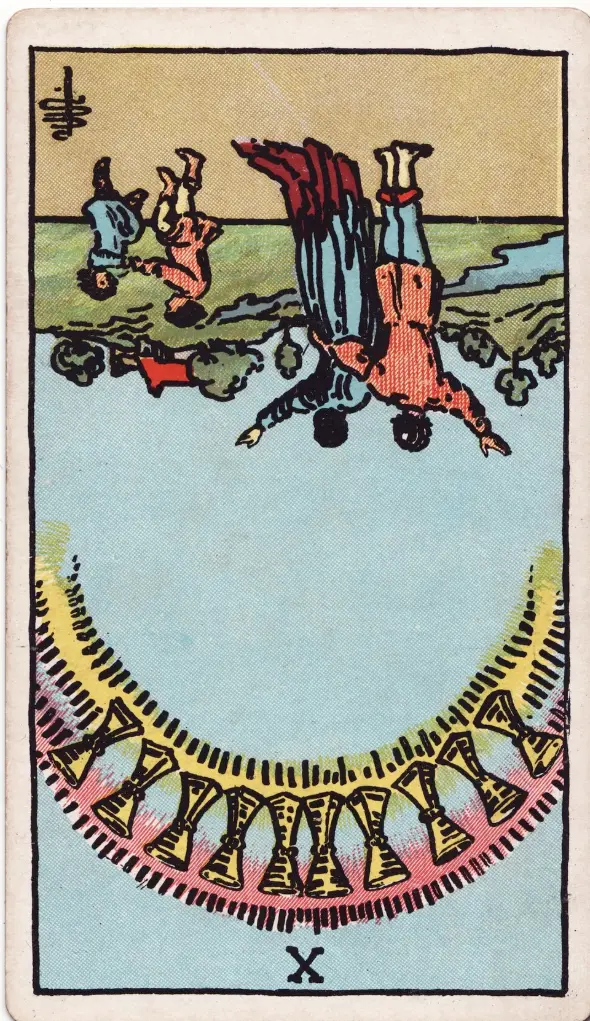
Ten of Cups reversed
Waite’s book gives the reversed Ten “repose of the false heart” first, then anger. Think of the holiday photo where everyone smiles, taken after two people stopped speaking at lunch. Or the in-laws who haven’t called since an argument over whose parents get Thanksgiving. His extra notes give the reversed card sorrow and a serious falling-out, and either scene fits.
Sometimes the trouble is the picture itself. A couple measures their real life against an ideal of the house, the dog and the perfect holidays, and the real one never quite measures up.
Ten of Cups in love
If you’re single, the upright Ten asks what kind of home life you actually want. Knowing you want quiet weekends and a table full of friends lets you say so early, before months go into the wrong match.
In a relationship, it’s the stage where two lives start sharing one calendar, with the same faces at the table every holiday. The card describes that ease. It doesn’t forecast a wedding or children, and our reading leaves both out.
Reversed, two partners may be picturing different homes, one a city apartment and the other a farmhouse two hours out. Relatives may also be pushing their idea of how you should live.
Career and work
The Ten suits a team where people genuinely look out for each other, or a family business that runs on trust. It also fits a job that gets you home in time for dinner.
Reversed, watch for the manager who says “we’re a family here” to explain unpaid weekends. A workplace can be friendly without being family, and the reversed card notices when that word is used as a lever.
Money
The Ten looks at what a household does with its money. A family might save up together for a holiday, or pick time together over more things.
Selling a house or making an investment calls for someone who knows your finances, and this card can’t stand in for them. Reversed, money goes into keeping up appearances, like an oversized party meant to show everyone the family is fine. Arguments about money at home often come with it.
Ten of Cups as feelings
This person feels at home with you. They can picture you at their table, with their people, on an ordinary Tuesday.
Reversed, daily life with you may fall short of the home they had in mind. Family opinions could also be weighing on them.
Ten of Cups as advice
Protect the plain time. Keep the weekly dinner, even in busy months.
With the card reversed, drop the picture-perfect standard. Have the honest talk, even if this year’s holiday photo comes out a little less polished.
Yes or no
With the Ten upright, the yes is firm, above all on home and belonging. Reversed, we’d hold back the yes until the people involved say out loud what they want.
Questions about the Ten of Cups
Does the Ten of Cups mean marriage?
Not as a prediction. Waite’s main entry speaks of contentment, love and friendship, and only his additional notes bring up a good marriage, for a male querent. We read the card as a happy household of any shape, and it says nothing about a wedding date.
Why aren’t the children looking at the rainbow?
Waite noticed it too. He wrote that the children haven’t seen the rainbow but are happy after their own fashion. We take them as the plainest part of the card’s meaning, contentment that doesn’t need a sign in the sky to be real.
Is the Ten of Cups the happiest card in tarot?
Readers often name it next to the Sun when they rank the happiest cards. Crowley’s Thoth deck gives it a less sunny title, Satiety, the state of having more than enough. We’d call it the most settled card of the Cups, happy in a quiet, everyday way.
Sources
- A. E. Waite, The Pictorial Key to the Tarot, London: William Rider & Son, first published 1910 (Wikisource transcribes the 1922 reprint). Public domain. Part III: the Ten of Cups with its divinatory and reversed meanings, the Ace of Cups (“house of the true heart”), and the additional meanings of the Lesser Arcana: Wikisource. Read November 20, 2026.
- Thoth Tarot, decans and card titles for the Suit of Cups (Ten of Cups: Pisces, third decan, Mars, Satiety): Wikipedia. Read November 20, 2026.
- Visconti-Sforza Tarot, the Cary-Yale deck: Wikipedia. Read November 20, 2026.
- Images: Ten of Cups, Rider-Waite-Smith deck, card art by Pamela Colman Smith, public domain, Wikimedia Commons. Ten of Cups, Cary-Yale Visconti tarot, 15th century, Beinecke Rare Book & Manuscript Library, public domain, Wikimedia Commons. Both file pages checked November 20, 2026.
Related cards
- Previous card: Nine of Cups
- Next card: Page of Cups
- All 78 tarot card meanings
- Free tarot reading