People often look this card up to find out if it means a win. Upright, the Chariot describes success through self-control, the kind that keeps a project moving when two demands pull apart. Reversed, that control breaks, and the push turns into aggression or simply stops.
Its seven is the same in the destiny matrix and in the Rider-Waite-Smith Major Arcana, where it comes straight after the Lovers.
| Upright keywords | Reversed keywords |
|---|---|
| Willpower, focus | Scattered effort, stalling |
| Self-control, momentum | Force without direction |
| A hard-won result, travel | Quarrels, losing the thread |
What the card shows
A curly-haired driver in armor rides in front of a walled town, in a cart made of gray stone. Over him hangs a blue canopy dotted with white stars, held up on four posts. His crown carries a single gold star, and two crescent moons with faces sit on his shoulders. A white square is set into the middle of his breastplate.
Look at his hands. The right one holds a long rod with a pointed tip, and the left rests on the rim of the cart. Nowhere does the card show reins.
Two sphinxes lie in front, a black one and a white one, both in striped headcloths. On the front of the cart a red emblem sits on a small shield, with a yellow disc and blue wings spread above it. A band of blue water separates the chariot from the red-roofed towers behind.
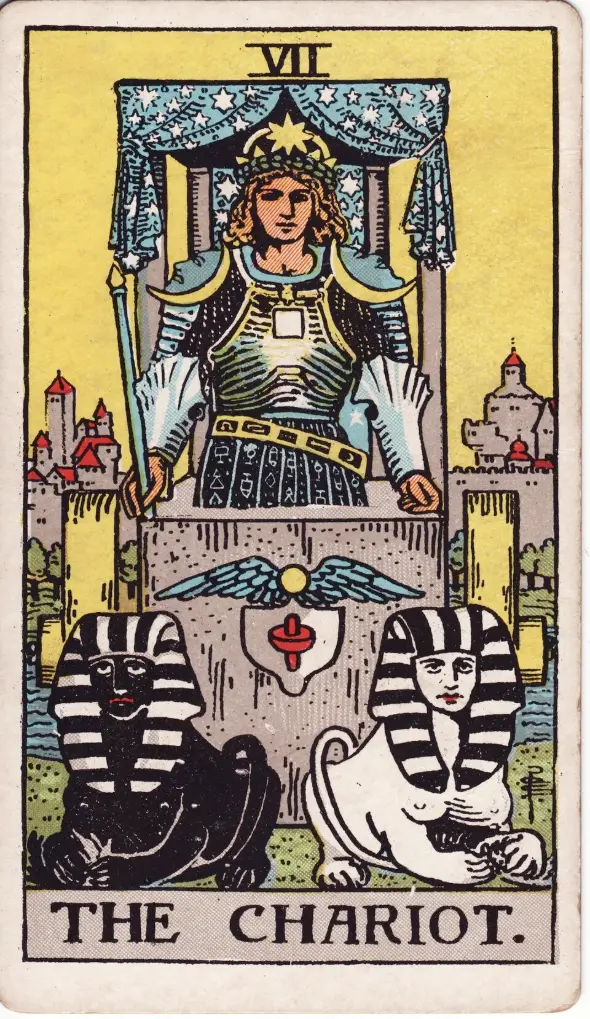
Waite’s text and Smith’s drawing don’t fully agree. He describes the figure as “carrying a drawn sword”, while she gave him the rod. On what the card means, Waite was brief:
“He is above all things triumph in the mind.”
A. E. Waite, author of The Pictorial Key to the Tarot (1910). Source: Wikisource, Part II, read November 15, 2026.
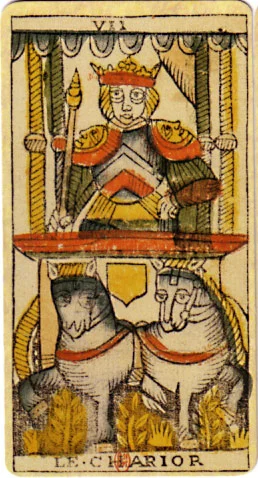
He also admitted that the sphinxes came from Éliphas Lévi, a French occultist. Older decks used horses, and Waite noted that in the eighteenth century “white horses were yoked to the car.” Jean Dodal’s Lyon card from the early 1700s fits that: a crowned king with a scepter rides behind two pale horses, and the shield on his cart is plain gold.
The Chariot upright
The upright card fits any stretch where the goal is clear and the hard part is staying on it. Finishing a degree while working full time is one example. A cross-country move with a rented truck and two kids in the back seat is another.
Each of those has two forces pulling against each other, and somebody has to keep them going one way. That is the job of the man between the sphinxes.
Waite’s divinatory list is less tidy than the modern “victory” reading:
“Succour, providence; also war, triumph, presumption, vengeance, trouble.”
A. E. Waite, divinatory meanings of the Chariot, The Pictorial Key to the Tarot (1910). Source: Wikisource, Part III, read November 15, 2026.
We read “presumption” as the warning inside the upright card. Someone who wins once can start to assume the road will always clear for them.
The Chariot reversed
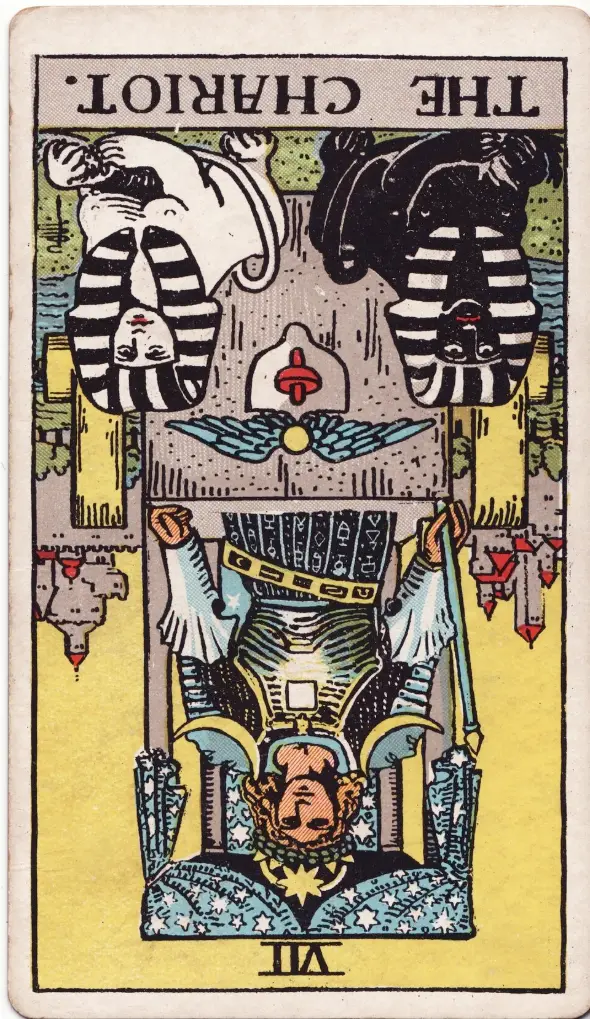
The reversed cart either stalls or runs off the road. One version is the person who pushes harder each week without asking where they’re going, like a boss who wins every argument and loses the team. The other version is drift. The sphinxes wander off, and the plan written in January is still on the whiteboard in June.
Waite’s reversed list is short and combative: “Riot, quarrel, dispute, litigation, defeat.”
We stay closer to those words than most current guides. Next to other cards of conflict, a reversed Chariot often describes a fight over direction, about who gets to steer. It gives no hint about how any dispute will end.
The Chariot in love
For anyone single, an upright Chariot favors going after what you want with some plan behind it. Ask the person out yourself instead of hoping the group trip does it for you. With movement among its themes, a meeting while traveling fits it too.
For a couple, it often shows two people pulled toward different goals. A job offer in another city and parents who live nearby is a typical case. The card asks you to agree on one direction before either of you starts driving.
Reversed, watch for a partner who treats the relationship as a contest to win. Or it can be a pair who stopped steering long ago and let routine choose for them.
Career and work
Deadlines suit the Chariot, and so do competitive pitches, sales targets and any job built around driving or travel, like trucking or tour management. It favors a project lead whose launch date can’t slip.
Upside down, ambition turns against itself. You chase a promotion so hard that colleagues stop helping, or a project has four directions and nobody picks one. Or everything stalls: the goal still matters to you, but you’ve stopped acting on it.
Money
No investment or big purchase should hang on this card. What it does describe is control. The upright card points to a savings target with a date attached, like a car bought outright after eighteen months of setting money aside.
Reversed, spending follows mood, or a big purchase gets made mostly to win a point with someone.
The Chariot as feelings
As a read on someone’s feelings, an upright Chariot describes a person who has decided they want you and is acting on it. Expect plans and invitations more than long talks about emotions.
A reversed card suggests their time and attention are split, and you get the smaller share. Or there’s a competitive streak between you that they wouldn’t admit to.
The Chariot as advice
Say out loud where you’re headed. Then cut the side trips that don’t serve it. Put the arrival date somewhere you will see it every morning.
If it lands reversed, stop and check the map. Ease off for a week if you’ve been forcing things. If you’ve been drifting, set one deadline and hold yourself to it.
Yes or no
The upright Chariot gets a yes from us, provided you’re willing to do the steering yourself. Reversed, we lean toward no, at least until you know which way you actually want to go.
The Chariot in the destiny matrix
Seven needs no conversion, unlike the Fool’s zero or the swapped pair of Strength and Justice.
The day point is the Chariot for anyone born on the 7th, and also on the 25th, because 2+5 gives 7. July puts it on the month point.
The year point needs birth-year digits that add up to 7 or to 25. No year from 1900 to 1968 does that. The first is 1969, and after it they come every nine years: 1978, 1987, 1996, 2005.
Across two full centuries of birth dates run through the calculator’s formula, a 7 lands in the center more often than on any other point, about once in every nine dates.
Run September 3, 1976 through the formula and the Chariot comes out as the center point:
| Step | Calculation | Result |
|---|---|---|
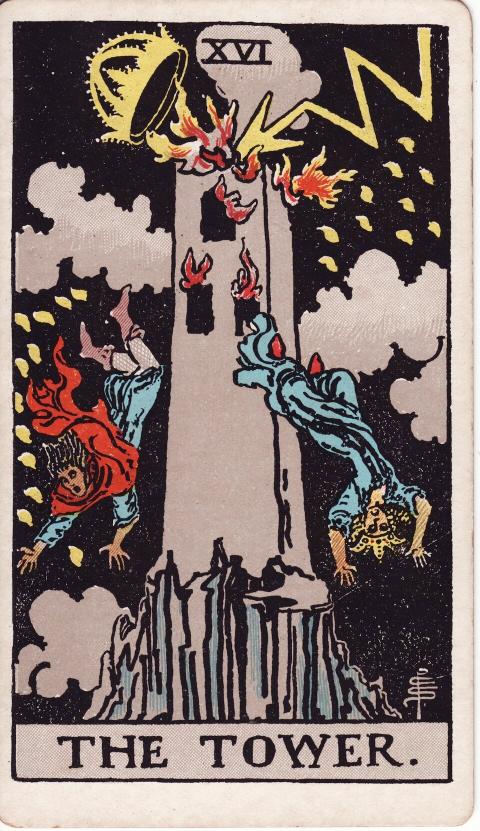
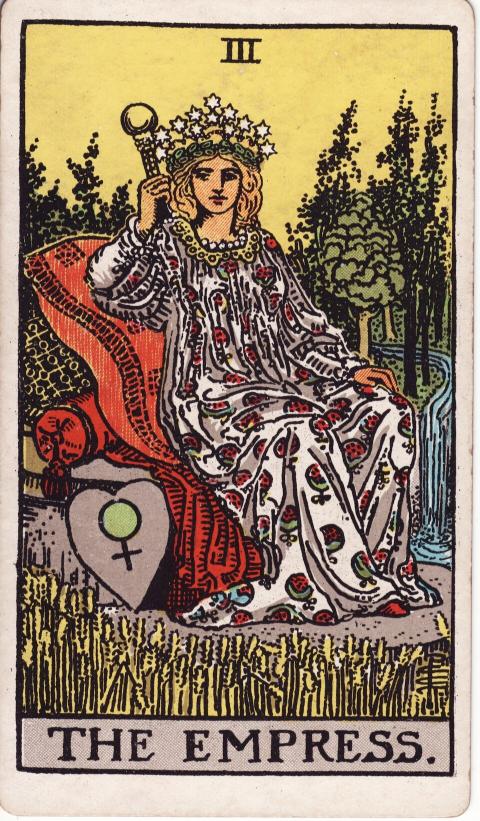
| Day point | 3 | 3, The Empress |
| Month point | 9 | 9, The Hermit |
| Year point | 1+9+7+6 = 23, then 2+3 | 5, The Hierophant |
| Bottom point | 3 + 9 + 5 | 17, The Star |
| Center | 3 + 9 + 5 + 17 = 34, then 3+4 | 7, The Chariot |
The date above is invented for the example.
In the calculator’s word list, Arcanum 7 is will, movement and goals, which most readers would also say of the upright Chariot. The destiny matrix calculator marks every point of a full chart where a 7 appears.
Questions about the Chariot
Why does the Chariot have sphinxes instead of horses?
Waite took them from Éliphas Lévi. Earlier decks, including the Marseille pattern, show horses. In his own history of the cards Waite admits the sphinx version “was invented to support a particular historical hypothesis”, yet he kept it for Smith’s design.
Why is the charioteer not holding any reins?
Smith drew none, and Waite never explains it. Most readers take it to mean he steers by will alone. That fits Waite’s line about triumph in the mind better than it fits a sword fight.
Is the Chariot linked to Cancer?
In occult tradition, yes. In The Book of Thoth, published in 1944, Crowley pairs the card with Cancer and its ruler, the Moon, and the crescents on the driver’s shoulders echo it. Your Sun sign doesn’t make this card more or less likely to turn up.
Can the Chariot mean a road trip or a new car?
Many readers say yes, and movement is one of the matrix keywords for Arcanum 7. Waite’s list never mentions trips, though. We’d read travel into it only when the question is about travel.
Sources
- A. E. Waite, The Pictorial Key to the Tarot, London: William Rider & Son, 1910. Public domain. Part I, the Chariot in older decks, the horses and the sphinx variation: Wikisource. Part II, the Chariot, the drawn sword and Lévi’s sphinxes: Wikisource. Part III, divinatory meanings: Wikisource. Read November 15, 2026.
- The Chariot (tarot card), the Cancer and Moon pairing from Crowley’s Book of Thoth: Wikipedia. Read November 15, 2026.
- Éliphas Lévi, French occultist: Wikipedia. Read November 15, 2026.
- Images: The Chariot, Rider-Waite-Smith deck, card art by Pamela Colman Smith, public domain, Wikimedia Commons. The Chariot (Le Chariot), Jean Dodal Tarot of Marseilles, between 1701 and 1715, public domain, Wikimedia Commons.
- Destiny matrix method and the Arcanum 7 keywords: as published on the free destiny matrix calculator page, checked November 15, 2026.
Related cards
- Previous card: The Lovers
- Next card: Strength
- All 78 tarot card meanings
- Free tarot reading