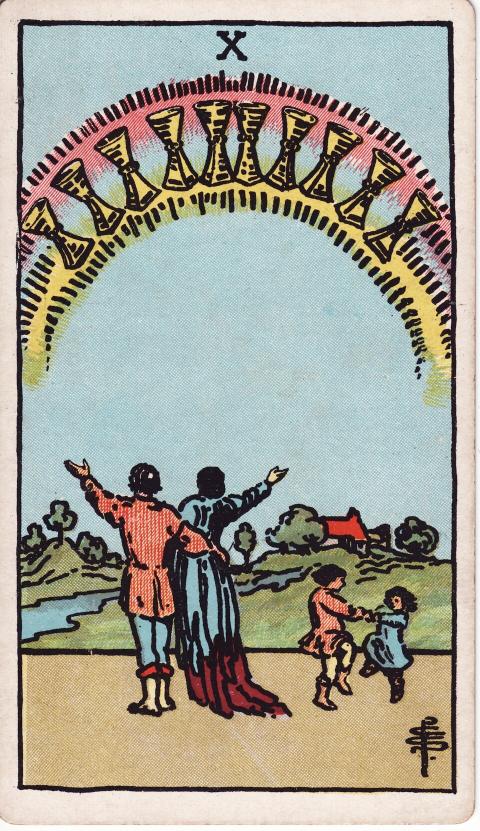
The upright Ace of Cups describes a feeling that starts to flow, like affection that takes you by surprise or a friendship that suddenly opens up. Reversed, the flow is blocked, and the feeling stays bottled up or spills onto the wrong person.
It opens the fourteen-card suit of Cups in the 78-card Rider-Waite-Smith deck, and it’s the only card of that suit with no full human figure, just a hand.
| Upright keywords | Reversed keywords |
|---|---|
| New affection, openness | Bottled-up feelings |
| Generosity, a full heart | Moods that overflow |
| Relief, being moved | A kind offer turned down |
What the card shows
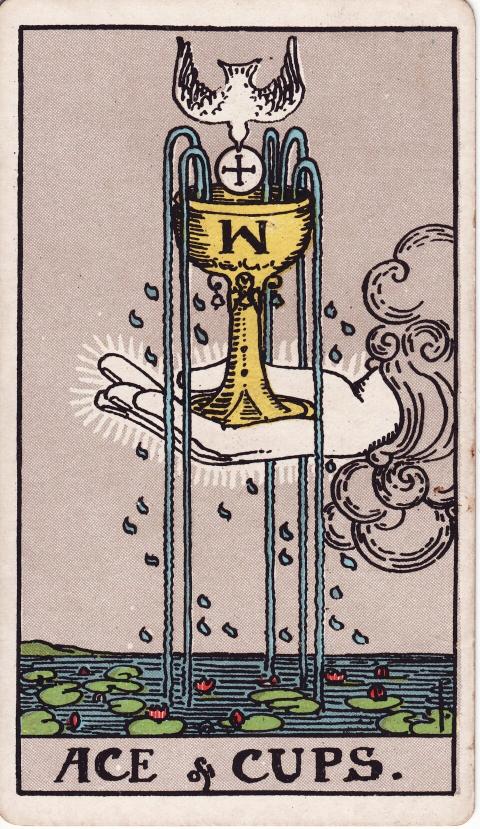
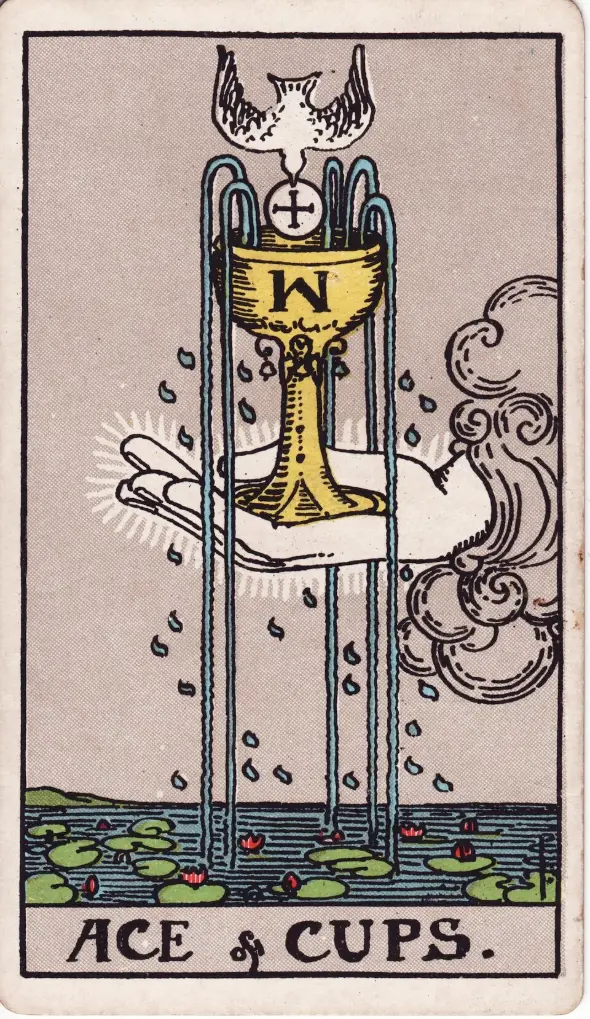
The background is plain gray, and nearly everything happens in a narrow column down the middle. A white hand reaches out of a gray cloud on the right, palm up, with short rays of light around it. On the palm stands a gold cup. A large letter is drawn on the bowl, and it reads as an upside-down M or as a W, depending on how you hold it.
Above the cup, a white dove dives head first. In its beak is a round white wafer marked with a cross, which Waite calls the Host, the word churches use for Communion bread. Water spills over the rim in thin streams down to a pond with green lily pads and small red water lilies. Blue drops fall through the air on every side.
Count the streams and you get five. Waite’s text says “four streams” pour from the cup, so Smith drew one more than he described. He saw this card as a hint at something deeper in the minor cards:
“It is an intimation of that which may lie behind the Lesser Arcana”
A. E. Waite, on the Ace of Cups, The Pictorial Key to the Tarot (1910). Source: Wikisource, Part III, read November 20, 2026.
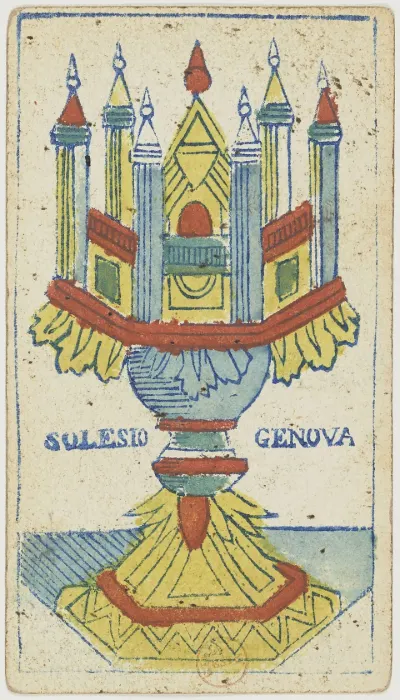
Smith gave every numbered minor card a scene, “the Aces only excepted,” in Waite’s words. Older decks drew this Ace without any of those symbols. In a Piedmontese pack printed by F. F. Solesio in Genoa in 1865, the Ace is one big cup built like a small castle, with towers rising from its rim and the maker’s name across the middle. It has no hand and no dove.
Ace of Cups upright
This Ace belongs to the first rush of a feeling, before anyone has decided what to do about it. A first date ends and you’re both texting within the hour. A brother you haven’t spoken to in two years calls on your birthday, and the call runs long. You start walking dogs at a shelter on Saturdays and catch yourself looking forward to it all week.
Plenty of what the card covers isn’t romantic, like crying through a friend’s wedding toast or finishing your first song in years.
Waite opens his list of meanings with a phrase we like:
“House of the true heart, joy, content”
A. E. Waite, divinatory meanings of the Ace of Cups, The Pictorial Key to the Tarot (1910). Source: Wikisource, Part III, read November 20, 2026.
The list continues with “abode”, which means a home. We take “house of the true heart” as a place where feelings are allowed in, which suits the open palm on the card.
Ace of Cups reversed
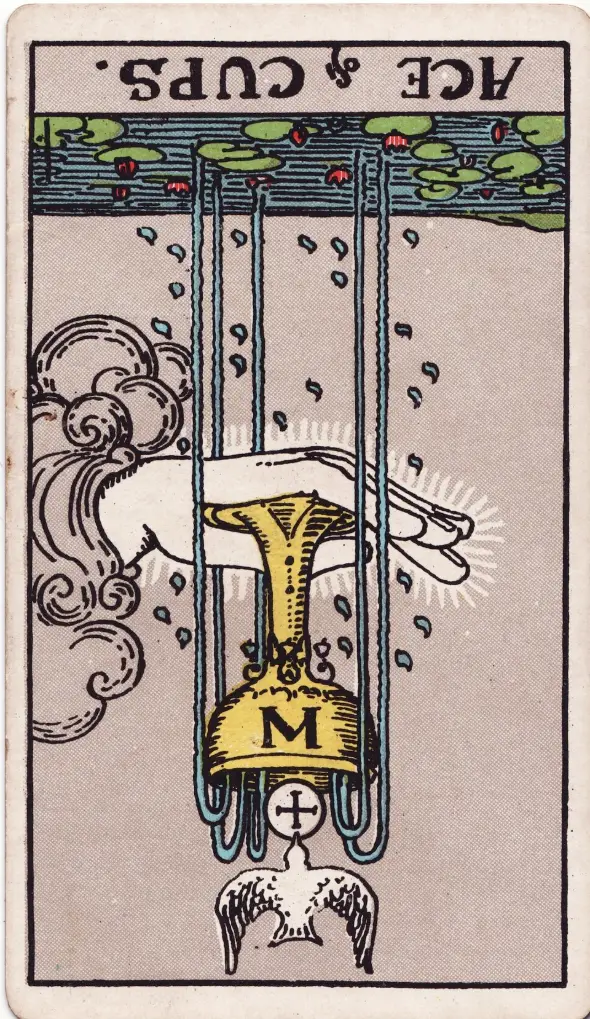
Hold the card upside down and the cup empties onto the table instead of into the pond. In the quiet kind of reversal, you like someone and keep things light, because saying more feels risky. The loud kind spills over, like snapping at a coworker about something that happened at home, or texting an ex at 1 a.m.
“House of the false heart, mutation, instability, revolution.”
A. E. Waite, divinatory meanings of the Ace of Cups reversed, The Pictorial Key to the Tarot (1910). Source: Wikisource, Part III, read November 20, 2026.
“False heart” is the phrase we use most. It covers feelings that are performed instead of felt, such as a cheerful “I’m fine” on a bad week, or a big romantic gesture made mostly for an audience.
Ace of Cups in love
Single readers may notice they’re more open than they were six months ago. If someone new makes you laugh, let yourself enjoy it before you analyze it.
In a relationship, it fits a fresh round of tenderness. That might be the first “I love you”, or a couple who start talking properly again after a cold stretch.
Reversed, the love is there but stuck. One partner offers warmth and gets politeness back. Sometimes a person still carries an old hurt, and there’s no room in the cup for anything new.
Career and work
At work, the Ace leans toward caring roles like teaching, youth work or running a community space. It also marks the start of a project you love for its own sake, such as a side business baking cakes or a first paid art commission.
Reversed, the caring side of the job can turn into routine, friendly on the surface and empty underneath. Or a creative project has stalled because you stopped enjoying it.
Money
Look elsewhere for timing a purchase, a sale or an investment. This Ace is about how freely you give, from birthday gifts to the coffee you buy for the team.
Upright, that generosity stays in proportion to what you have. The reversed card shows money spent to win affection, or a bad-day shopping trip you regret on payday.
Ace of Cups as feelings
The warmth they feel for you is new to them and a little overwhelming. They may not have the words yet, but they brighten when you walk in.
Reversed, they keep it to themselves. They might be shy, or still tangled up with someone else.
Ace of Cups as advice
Let it in. If someone offers help or a seat at their table, accept it without talking yourself out of it.
Reversed, find the place where you’re blocking yourself. Start small, with a thank-you or an apology you still owe someone.
Yes or no
Yes, upright, and a strong one on matters of feeling. Reversed, we’d call it a no until whatever is held back gets said.
Questions about the Ace of Cups
Why do I keep pulling the Ace of Cups?
A card that keeps coming back usually marks a theme you haven’t acted on. With this Ace, we’d ask which feeling or offer you keep setting aside. Shuffle well too, since repeats can come from a deck that isn’t mixed.
Is the letter on the Ace of Cups a W or an upside-down M?
Waite’s description of the card never mentions the letter, so he gives no answer. Readers have offered many guesses, Mary and water among them. We note it and don’t build a reading on it.
Does the Ace of Cups have a zodiac sign?
Not in the Thoth deck, which calls it the Root of the Powers of Water and leaves the sign blank. Its numbered Cups, Two to Ten, run through Cancer, Scorpio and Pisces, the three water signs.
Sources
- A. E. Waite, The Pictorial Key to the Tarot, London: William Rider & Son, 1910. Public domain. Part III, introduction to the Lesser Arcana (“the Aces only excepted”) and the Ace of Cups with its divinatory meanings: Wikisource. Read November 20, 2026.
- Rider-Waite Tarot: Smith’s scenes on the Minor Arcana and the simpler designs of earlier decks: Wikipedia. Read November 20, 2026.
- Thoth Tarot, table of attributions for the suit of Cups: Wikipedia. Read November 20, 2026.
- Images: Ace of Cups, Rider-Waite-Smith deck, card art by Pamela Colman Smith, 1910, public domain, Wikimedia Commons. Ace of Cups, Piedmontese tarot deck, F. F. Solesio, Genoa, 1865, public domain, Wikimedia Commons. Both file pages read November 20, 2026.
Related cards
- Previous card: King of Cups
- Next card: Two of Cups
- All 78 tarot card meanings
- Free tarot reading