Readers nicknamed the Nine of Cups the wish card, but its picture shows a wish already met: a man content with what he has. Upright, that’s satisfaction, sometimes with a little showing off. Reversed, it can mean smugness or a win that feels hollow, although truth and loyalty come first in Waite’s own reversed list.
In the Minor Arcana, the Nine sits one place before the Ten of Cups. Its Thoth title, in Crowley’s deck, is plain Happiness, with Jupiter ruling the second decan of Pisces.
| Upright keywords | Reversed keywords |
|---|---|
| Contentment, satisfaction | Smugness, showing off |
| A wish already met | Honesty, loyalty |
| Comfort, enjoying the moment | A win that feels empty |
What the card shows
A stout man sits on a low wooden bench, knees apart, feet planted on yellow ground. He has folded his arms, and his round face wears a small, pleased smile. A red cap with a red plume at one side sits on his head, and he wears a long white robe hatched with black stripes, red stockings and soft pale shoes.
Behind him runs a curved counter covered in blue cloth that falls in heavy folds to the floor. Nine gold cups stand along its top in an arc, like trophies on a shelf. The whole backdrop is plain yellow, without a hill or a horizon to place him.
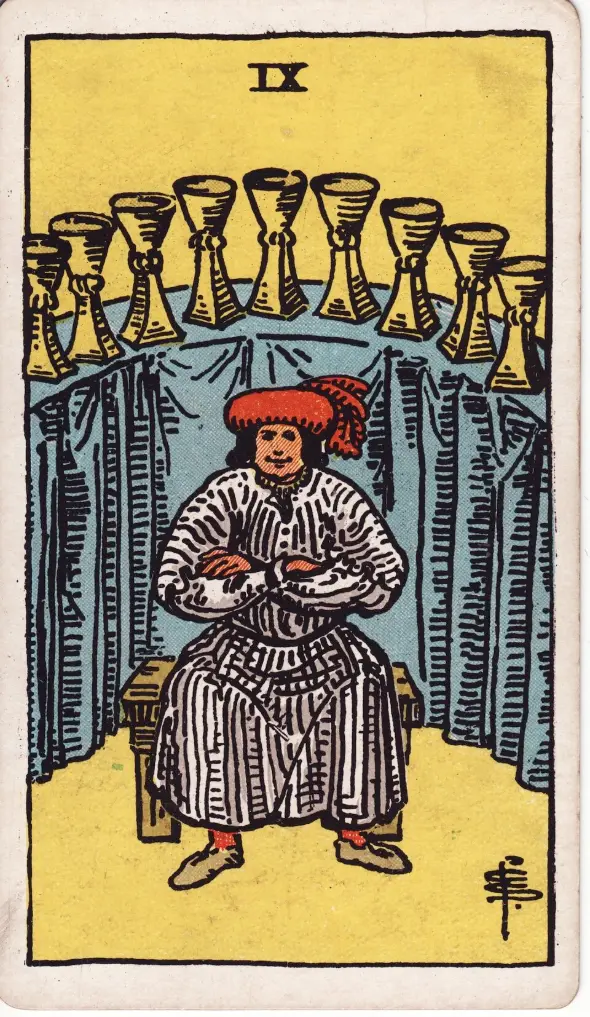
“A goodly personage has feasted to his heart’s content”
A. E. Waite, on the picture of the Nine of Cups, The Pictorial Key to the Tarot (1910). Source: Wikisource, Part III, read November 20, 2026.
Yet no food appears on the card. Waite went on to say the wine on the counter seems to promise a secure future, then admitted the picture shows only the material side of things.
Painted in Milan in the 1400s, the Cary-Yale Visconti version is a plain grid of nine cups, three by three, on silver dotted with gold rosettes. No figure sits in front of them. Smith added the owner, and his folded arms are what readers still argue about.
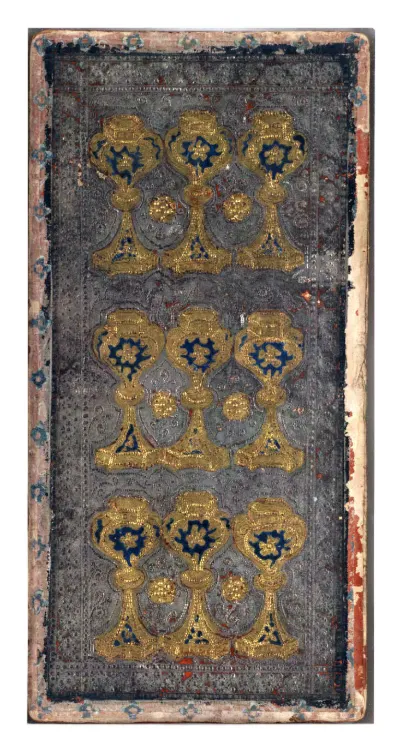
Nine of Cups upright
Picture the evening after a long push ends well. The kitchen renovation is finally done, and you eat takeout at the new counter with nothing planned. The rescue dog you applied for in March is asleep on your feet. The thesis is submitted, and for one weekend nobody needs anything from you.
Concord, contentment, victory and success all appear in Waite’s divinatory list, and the last item is satisfaction for the person asking. To us, that satisfaction has already arrived. The cups stand behind the man, already his, instead of floating somewhere ahead.
The pose has some display in it. He sits facing out in front of his trophies, as if someone were about to take his photo. He enjoys what he’s earned, and he wants people to see it.
Nine of Cups reversed
“Truth, loyalty, liberty; but the readings vary and include mistakes, imperfections, etc.”
A. E. Waite, the Nine of Cups reversed, The Pictorial Key to the Tarot (1910). Source: Wikisource, Part III, read November 20, 2026.
That’s a generous reversal, and Waite admits in the same breath that readers disagree. Modern guides lean the other way, toward smugness and excess.
We use both. Sometimes the reversed Nine is the moment the act drops and the truth comes out. A friend whose move abroad looked perfect online tells you over the phone that it’s been lonely. Other times it’s a win that went flat, like the bigger apartment that mostly feels empty once the furniture is in.
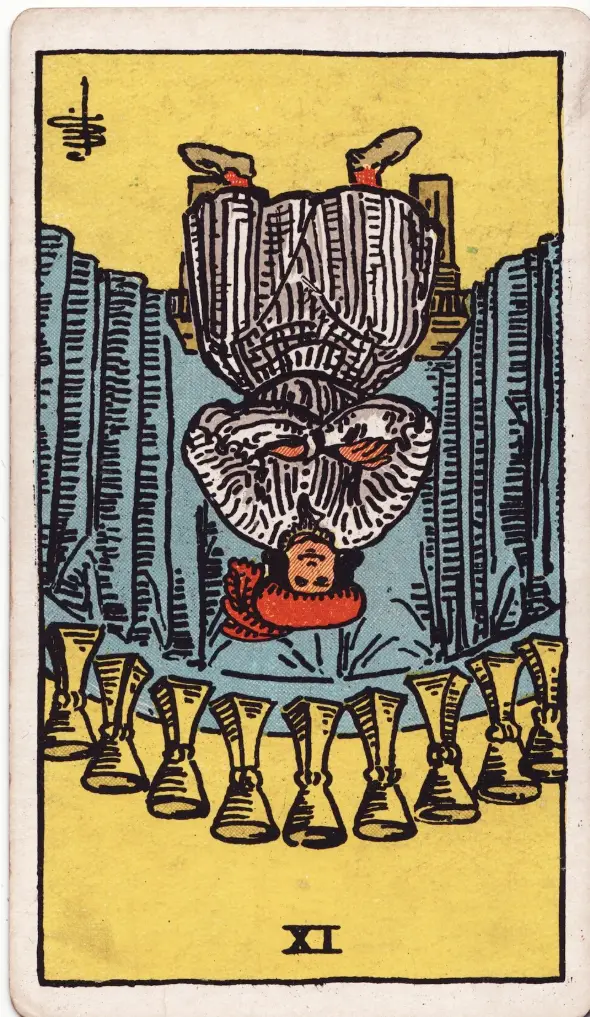
Nine of Cups in love
Under this card, single people tend to like their own company. A good match would be welcome, but a quiet Friday with a book doesn’t feel like second prize.
If you’re in a relationship, the Nine usually means things are comfortable, with nothing urgent to fix. That has a risk. Small gestures can stop once both of you are this comfortable.
Reversed, the couple people see online and the couple at home may not match. The anniversary post gets two hundred likes, and the dinner itself was mostly quiet. Waite’s reversed reading suggests the way out, which is saying the true thing aloud.
Career and work
Professionally, the Nine fits reaching a goal you set yourself, such as a coffee shop that finally has regulars who order “the usual”.
Reversed, it can point to coasting on one old success, or a job history that rounds up a little too much. Waite’s “mistakes, imperfections” fit here, as the small errors a proud person won’t own.
Money
The Nine is content with what’s already paid for. Driving the same car for ten years because you like it, or taking a trip covered by savings, sits well with this card.
Whether to buy shares or sell a house is a question we never put to the Nine. Upside down, it’s spending for an audience, like an upgrade bought so other people will notice.
Nine of Cups as feelings
Being with you seems to satisfy them, with little worry underneath.
Reversed, they may be acting happier than they are. Or something is going unsaid, and the cheerful front is covering it.
Nine of Cups as advice
Name what you wanted a year ago. If you have it now, enjoy it for a full day before you think about the next goal.
If it comes up reversed, the card asks for honesty, starting with yourself. Is the thing you’re chasing still what you want, or only what you once said you wanted?
Yes or no
Upright, the Nine says yes to how you’d feel about the outcome, and leaves the events themselves open. Reversed, we’d stop at maybe until you’ve taken an honest look at what you’re really asking for.
Questions about the Nine of Cups
Why is the Nine of Cups called the wish card?
The nickname comes from later readers, not from Waite, whose entry for this card never uses the word “wish”. The picture explains it well enough, since it shows a man sitting in front of everything he wanted. None of the sources we read say who first used the name.
Will my wish come true if I pull the Nine of Cups?
Nothing in a spread can make it happen. Try it as a question instead: if the wish came true tomorrow, would you feel like the man on the bench? Your answer shows how much the wish matters to you.
Why are the man’s arms crossed on the Nine of Cups?
Waite never mentions the arms, so the meaning is open. Some readers see a closed, smug pose, others a man at ease with nothing left to reach for. Given the smile and the planted feet, we read contentment first, with a little pride mixed in.
Sources
- A. E. Waite, The Pictorial Key to the Tarot, London: William Rider & Son, first published 1910 (Wikisource transcribes the 1922 reprint). Public domain. Part III: the Nine of Cups, its divinatory and reversed meanings, and the additional meanings of the Lesser Arcana (checked for the word “wish”): Wikisource. Read November 20, 2026.
- Thoth Tarot, decans and card titles for the Suit of Cups (Nine of Cups: Pisces, second decan, Jupiter, Happiness): Wikipedia. Read November 20, 2026.
- Visconti-Sforza Tarot, the Cary-Yale deck and its silver-ground pip cards: Wikipedia. Read November 20, 2026.
- Images: Nine of Cups, Rider-Waite-Smith deck, card art by Pamela Colman Smith, public domain, Wikimedia Commons. Nine of Cups, Cary-Yale Visconti tarot, 15th century, Beinecke Rare Book & Manuscript Library, public domain, Wikimedia Commons. Both file pages checked November 20, 2026.
Related cards
- Previous card: Eight of Cups
- Next card: Ten of Cups
- All 78 tarot card meanings
- Free tarot reading