The Knight of Cups rides in slowly with an offer and holds it out like a gift. Upright, that means invitations, romantic approaches and proposals of many kinds. Reversed, it can be an offer that sounds better than it is, and Waite names fraud outright.
He’s the third Cups court card in the 78-card deck, with the Page under him and the Queen and King above.
| Upright keywords | Reversed keywords |
|---|---|
| An offer, an invitation | Empty promises |
| Romance, courtship | Trickery, a smooth pitch |
| Following your heart | Moodiness, unreliability |
What the card shows
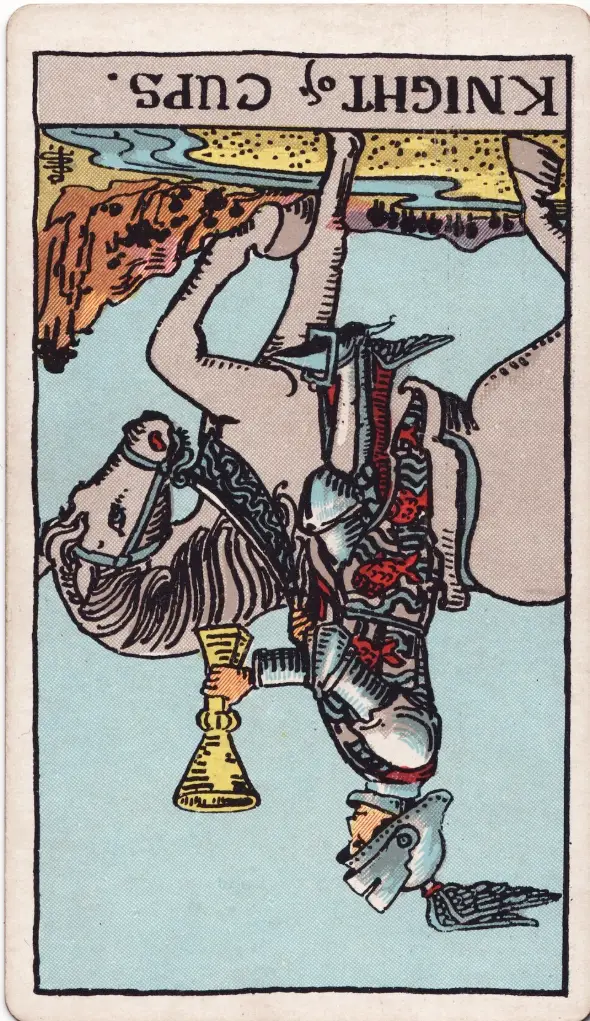
A knight in silver armor rides a gray horse at a walk, heading to the right. A gold cup is held straight out in front of him at chest height, steady, as if he were carrying it to someone. A wing rises from the top of his helmet, and a smaller one sits at his heel.
Over the armor he wears a tunic printed with red fish and wavy lines like water. The horse keeps its head low and lifts one front hoof, unhurried. Below them a narrow stream winds across speckled sandy ground. A red-brown cliff with dark trees rises on the right, and low purple hills fill the distance on the left.
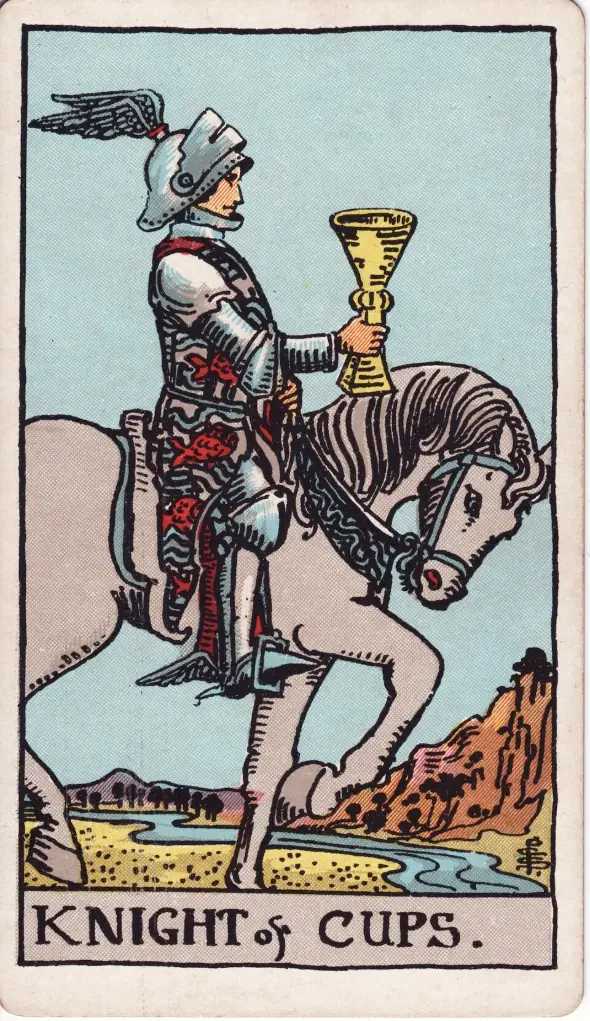
“Graceful, but not warlike; riding quietly, wearing a winged helmet”
A. E. Waite, on the picture of the Knight of Cups, The Pictorial Key to the Tarot (1910). Source: Wikisource, Part III, read November 20, 2026.
Waite connects the wings with the imagination and calls this knight a dreamer, one whose visions are full of things he can see and touch. He wears armor, but nothing about him is charging.
The 15th-century Cary-Yale Visconti knight goes without armor. A fair-haired young man in a red and gold tunic rides a white horse draped in red cloth patterned with gold crowns. His raised cup is only an outline pressed into the gold leaf, easy to miss on a first look.
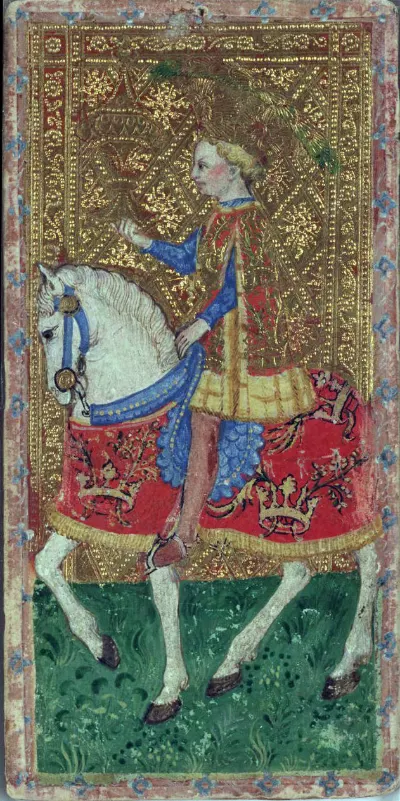
Knight of Cups upright
This Knight’s offers come with a little ceremony. A date asks you out with a handwritten card instead of a text. A former classmate calls about making a short film together and has already storyboarded the opening.
Waite starts his list with arrival and approach, then continues:
“advances, proposition, demeanour, invitation, incitement”
A. E. Waite, divinatory meanings of the Knight of Cups, The Pictorial Key to the Tarot (1910). Source: Wikisource, Part III, read November 20, 2026.
Demeanour is the interesting word there. It means manner, and this Knight cares how the cup is handed over.
Knight of Cups reversed
“Trickery, artifice, subtlety, swindling, duplicity, fraud.”
A. E. Waite, the Knight of Cups reversed, The Pictorial Key to the Tarot (1910). Source: Wikisource, Part III, read November 20, 2026.
Turned over, the charming messenger becomes a salesman. Think of the date who texts beautifully and never confirms a plan, or a pitch for a “can’t lose” opportunity delivered with a big smile. The cup is still held out. Ask to see what’s in it.
In a gentler reversal, the dreamer turns moody when life doesn’t match the picture in his head.
Knight of Cups in love
This is the classic courtship card. For someone single, it can show a person approaching with real interest and a bit of style, like flowers sent to the office or an evening planned down to the restaurant’s best table.
After years together, he still courts you and plans the trip in secret.
Reversed, watch for words that outrun actions. Big declarations in the first week can be followed by silence. Some people also enjoy being in love more than they enjoy the person in front of them.
Career and work
His working life runs on offers and pitches. It suits sales, design, music and any job where charm and taste help. Upright, an offer may come your way, or you may be the one making the pitch.
Upside down, he promises more than he can deliver, or the contract reads worse at home than it did in the meeting.
Money
With this Knight, feelings decide the spending. You buy the gift because it’s perfect, or book the trip because the moment felt right. That works when you’ve counted the cost first.
This Knight brings offers, and it can’t tell you whether a financial one is sound. Don’t read it as a push toward any purchase, sale or investment. Reversed, it’s a fair warning about pitches that promise easy returns.
Knight of Cups as feelings
They’re romantically interested and want to act on it. They may also idealize you a little.
Reversed, strong feelings come and go without warning.
Knight of Cups as advice
Make the offer, and take your time making it. Say what you feel in your own words, at a pace the other person can match.
With the Knight reversed, ask for specifics before you say yes, in writing if money is involved.
Yes or no
Upright, we’d accept what the Knight is offering, which makes this a yes. Reversed, the details need checking before any yes.
Questions about the Knight of Cups
Is the Knight of Cups a proposal card?
It can be. Waite’s list includes proposition and invitation, though he never says marriage. We read it as an offer of any kind, romantic or not, and never as a promise that a ring is coming.
Is the Knight of Cups a player?
Upright, not usually, since he’s sincere if dreamy. The player reading comes from the reversed card, where Waite lists trickery and duplicity. Judge by follow-through: charm with a plan fits the upright Knight, and charm alone fits the reversed one.
Why does the Knight of Cups have wings on his helmet?
Waite ties the wings to the higher reaches of imagination. Readers often think of Hermes, the winged messenger of Greek myth, which suits a knight who arrives carrying something. Smith added a smaller wing at his heel as well.
Why is the Knight of Cups’ horse walking so slowly?
Smith drew the horse at a walk with its head down, and Waite says this knight rides quietly and isn’t warlike. Next to the galloping Knight of Swords, the pace stands out. We read it as care, since he’s carrying a cup and doesn’t want to spill it.
Sources
- A. E. Waite, The Pictorial Key to the Tarot, London: William Rider & Son, first published 1910 (Wikisource transcribes the 1922 reprint). Public domain. Part III: the Knight of Cups with its picture text, divinatory and reversed meanings: Wikisource. Read November 20, 2026.
- Visconti-Sforza Tarot, the Cary-Yale deck, its surviving face cards and its six ranks: Wikipedia. Read November 20, 2026.
- Images: Knight of Cups, Rider-Waite-Smith deck, card art by Pamela Colman Smith, public domain, Wikimedia Commons. Knight of Cups, Cary-Yale Visconti tarot, 15th century, Beinecke Rare Book & Manuscript Library, public domain, Wikimedia Commons. Knight of Swords, Rider-Waite-Smith deck, for the comparison, Wikimedia Commons. File pages checked November 20, 2026.
Related cards
- Previous card: Page of Cups
- Next card: Queen of Cups
- All 78 tarot card meanings
- Free tarot reading