The Seven of Swords points to plans made in secret and carried out alone, sometimes cleverly and sometimes at someone else’s cost. Reversed, a hidden thing tends to surface, and Waite gave the card a turn toward advice and counsel.
Waite admitted that the card’s meanings are “widely at variance with each other.” Among the Minor Arcana, this is one card where we lean hardest on Smith’s picture.
| Upright keywords | Reversed keywords |
|---|---|
| Secrecy, quiet plans | A secret surfacing |
| Strategy, going it alone | Advice, counsel |
| Shortcuts, slipping away | Careless talk |
What the card shows
A man slips away on tiptoe to the left, five swords gathered against his chest. His head is turned back toward the camp, and under his red cap he is smiling. Two swords stay behind him, standing point down in the earth.
His tunic is olive green and covered in small dots, his tights are blue-gray, and his red boots have dark fur at the top. Striped tents with little pennants stand on the right. On the opposite side, far off, several small figures wait by a drift of gray smoke. One figure raises a long pole. The sky behind the whole scene is a flat, bright yellow.
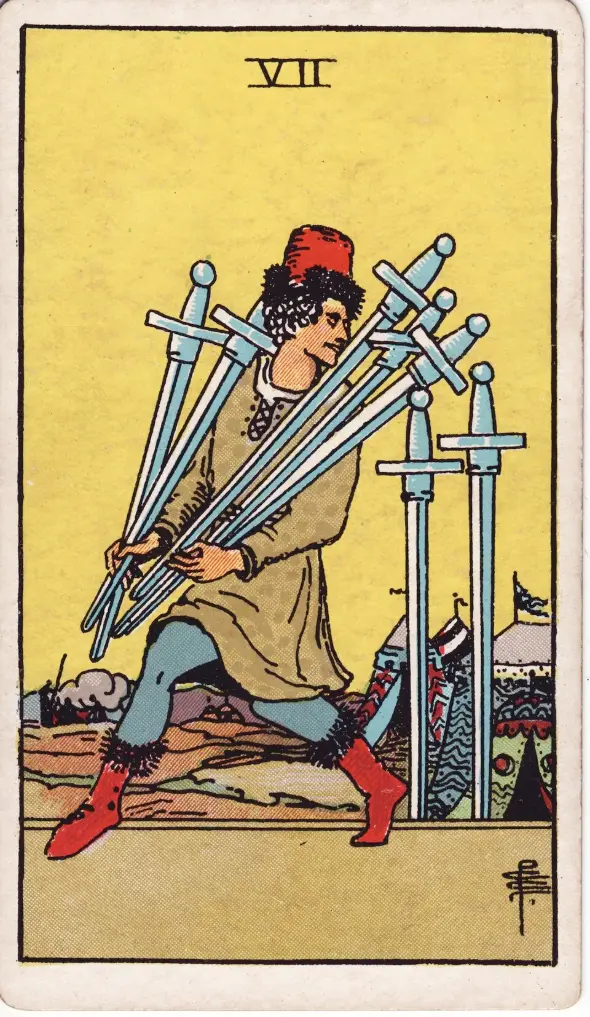
“A man in the act of carrying away five swords rapidly”
A. E. Waite, on the picture of the Seven of Swords, The Pictorial Key to the Tarot (1910). Source: Wikisource, Part III, read November 22, 2026.
In the Cary-Yale Visconti pack, the Five and the Seven share one layout. Curved blue blades meet in an X, six of them on the Seven, and one straight sword runs up the center, grip at the bottom.
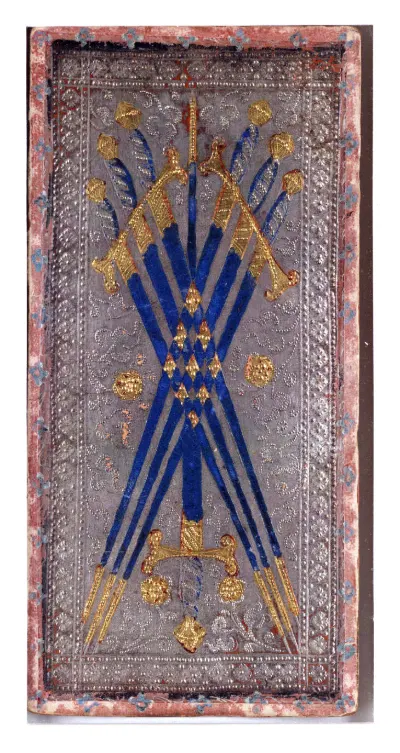
Seven of Swords upright
You book a week of walking in Scotland and tell your family only when the train tickets are printed. At bar trivia, someone on your team checks answers on a phone under the table. A neighbor takes your parking spot every night and has driven off by six each morning.
“Design, attempt, wish, hope, confidence; also quarrelling, a plan that may fail, annoyance.”
A. E. Waite, divinatory meanings of the Seven of Swords, The Pictorial Key to the Tarot (1910). Source: Wikisource, Part III, read November 22, 2026.
Up to the word confidence, the list is about intent, a person with a design who is ready to try it. Its tail end warns that the plan may fail or start a fight.
Seven of Swords reversed
“Good advice, counsel, instruction, slander, babbling.”
A. E. Waite, the Seven of Swords reversed, The Pictorial Key to the Tarot (1910). Source: Wikisource, Part III, read November 22, 2026.
Every item on that list is a kind of talk, some of it worth hearing and some of it harmful. Your brother, who has moved six times, tells you to photograph every room as soon as you get the keys. At the dog park, a story about why the couple at number 12 moved out makes the rounds three times by lunch.
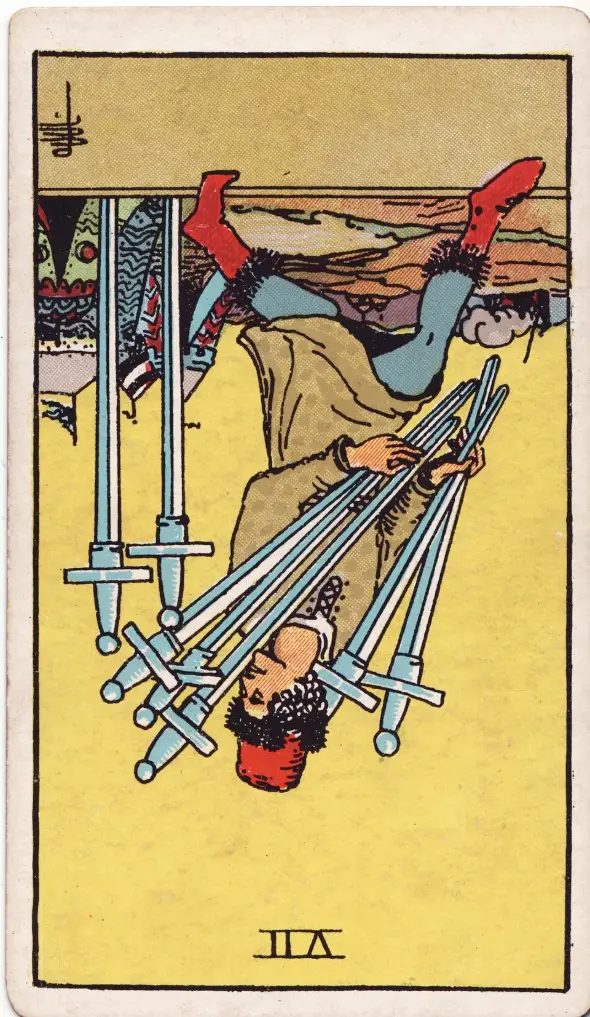
In his additional meanings, Waite expects that advice to be “probably neglected.” In our readings the reversal also covers a secret ending, either because somebody talks or because the person keeping it decides to stop.
Seven of Swords in love
Early on, you might keep a new person to yourself for a month or two and not mention them to friends. Privacy like this is harmless. On a dating app, it may show someone who keeps their plans vague, such as whether they’re staying in town past the summer.
Once you’ve been together a while, the Seven often points to something one of you hasn’t mentioned. It might be money lent to a brother, or a plan to retrain as an electrician.
Reversed, the thing gets said. The loan comes up over dinner, and the whole evening turns into a talk about why it stayed quiet so long.
Career and work
The Golden Dawn’s text names the card the Lord of Unstable Effort, paired with the Moon in Aquarius, and speaks of “yielding when victory is within grasp.” That line could describe a volunteer who runs a charity fun run for months, then hands it off a week from race day.
On the upright side, a shop assistant builds the owner a website at home and shows it only once it works.
Turned over, your quiet plan is found out early, like a job application left on the shared printer.
Money
Upright, spending tends to happen out of sight. One person tells the family the new bike cost half what it did. Another keeps a jar of cash at the back of a drawer for a trip nobody knows about.
We don’t count the Seven as a green light to invest, sell or make a big purchase.
Reversed, money talk gets loose, and a friend lets half the neighborhood know what you paid for your house.
Seven of Swords as feelings
They’re keeping some of their interest in you under wraps. Caution may explain it, or they’re still unsure of their own mind and don’t want to say so too soon.
Reversed, they’re close to saying what they’ve been sitting on.
Seven of Swords as advice
Sort the plan into what you can do alone and what needs other people’s agreement. Go ahead with the first part. For the second, talk to the people it affects.
Reversed, write down what the last three people you asked told you about this, and act on the point that came up more than once.
Yes or no
Upright, a plan that only works while nobody finds out is a no. Other plans earn a qualified yes, since he still gets five of the seven swords away. Reversed, with the secret already out, it’s a yes.
Questions about the Seven of Swords
Does the Seven of Swords show a theft?
Smith’s picture suggests it, with the tiptoe walk and the backward grin. Waite’s text only has a man carrying five swords away fast near a camp, and it never uses a word like theft.
Can the Seven of Swords show a cheating partner?
No. A reading isn’t evidence of anything a partner has done, and the Seven doesn’t hint at it either. Its subject is secrecy of any kind, and the secret in your spread may be a gift being planned or something of your own. When trust is what worries you, talk it over with your partner.
Why does the Seven of Swords show two swords left in the ground?
Probably because his arms were full. Left standing, they’re the part of the job he didn’t finish, and the part most likely to give him away.
Can the Seven of Swords be about my own secret?
It may well be, especially when the question was about you. Start with what you’re keeping quiet and why.
Sources
- A. E. Waite, The Pictorial Key to the Tarot, London: William Rider & Son, first published 1910 (Wikisource transcribes the 1922 reprint). Public domain. Part III: the Seven of Swords, its picture text, divinatory and reversed meanings, and the additional meanings of the Lesser Arcana: Wikisource. Read November 22, 2026.
- The Equinox, Vol. I, No. 8 (London, 1912), “A Description of the Cards of the Tarot with their Attributions”, item XLI, the Lord of Unstable Effort (pages 191 to 192): PDF copy. Read November 22, 2026.
- Images: Seven of Swords, Rider-Waite-Smith deck, card art by Pamela Colman Smith, public domain, Wikimedia Commons. Seven of Swords, Cary-Yale Visconti tarot, 15th century, Beinecke Rare Book & Manuscript Library, public domain, Wikimedia Commons. Both file pages checked November 22, 2026.
Related cards
- Previous card: Six of Swords
- Next card: Eight of Swords
- All 78 tarot card meanings
- Free tarot reading